
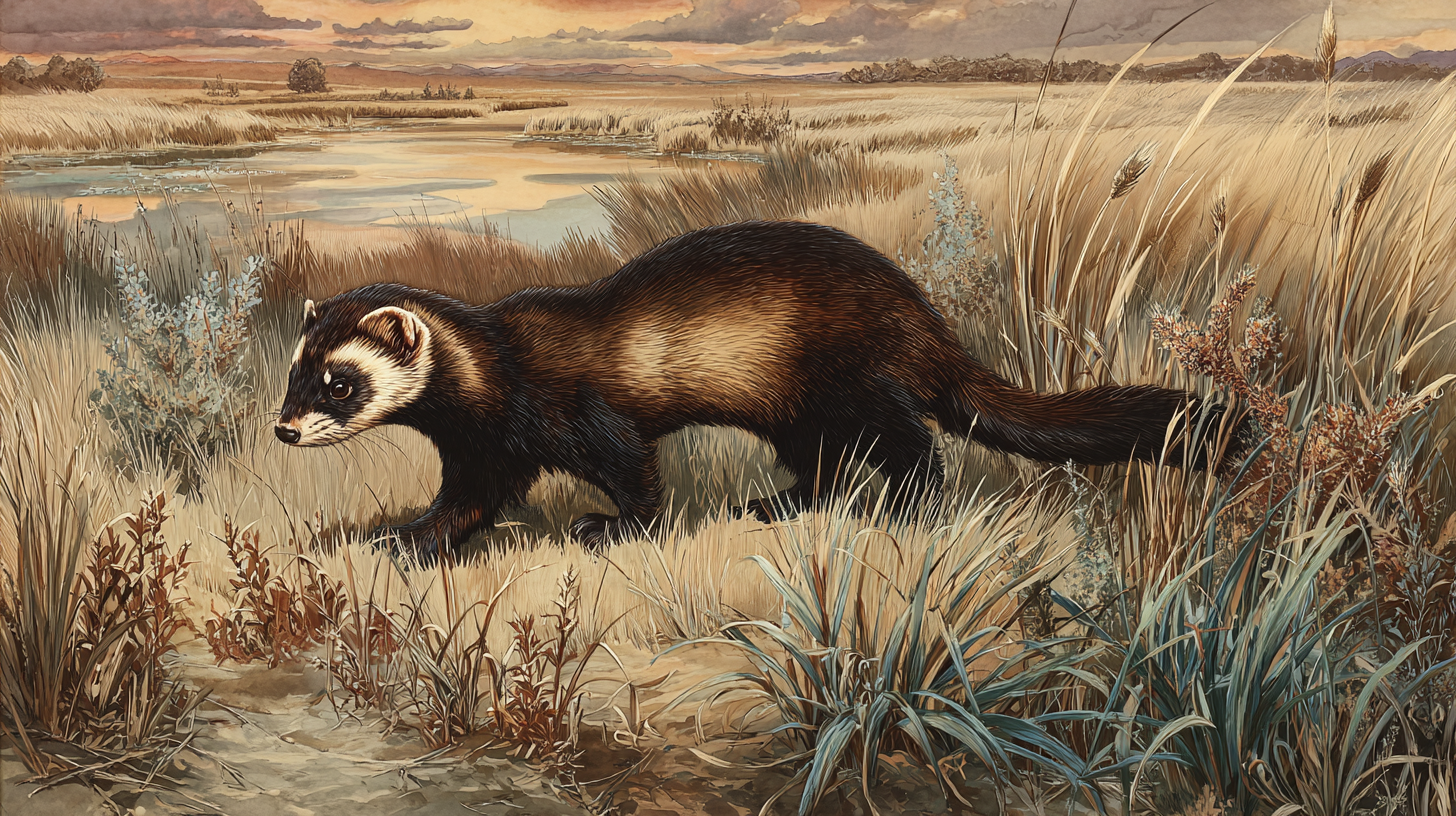
That is an American Polecat (black-footed ferret), our avatar for our newest Critter Stack project.
Mostly for my own sake to collect my own thoughts, I wanted to do a little update on the Critter Stack roadmap as it looks right now. This is an update on Critter Stack Roadmap for 2026 from December. Things have changed a little bit, or really just become more clear. While the rest of the Critter Stack core team has been early adopters of AI tools, I was late to the party, but two weeks into my own adoption of Claude Code, my ambition for the year has hugely expanded and this new update will reflect that.
Also, we’ve delivered an astonishing amount of new functionality in the first six weeks for 2026:
- Marten’s new composite projection capability that is already getting usage. This feature is going to hopefully make it much easier to create denormalized “query model” projections with Marten to support reporting and dashboard screens
- Wolverine got rate limiting middleware support (community built feature)
- Wolverine’s options for transactional middleware, inbox, outbox, and scheduled messaging support grew to include Oracle, MySql, Sqlite, and CosmosDb. Weasel support for Critter Stack style “it just works” migrations were added for Oracle, MySql, and Sqlite as well
Short to Medium Term Roadmap
I think we are headed toward a Marten 9.0 and Wolverine 6.0 release this year, but I think that’s 2nd or even 3rd quarter this year.
CritterWatch
My personal focus (i.e. JasperFx’s) is switching to CritterWatch as of today. We have a verbal agreement with a JasperFx Software client to have a functional CritterWatch MVP in their environment by the end of March 2026, so here we go! More on this soon as I probably do quite a bit of thinking and analysis on how this should function out loud. The MVP scope is still this:
- A visualization and explanation of the configuration of your Critter Stack application
- Performance metrics integration from both Marten and Wolverine
- Event Store monitoring and management of projections and subscriptions
- Wolverine node visualization and monitoring
- Dead Letter Queue querying and management
- Alerting – but I don’t have a huge amount of detail yet. I’m paying close attention to the issues JasperFx clients see in production applications though, and using that to inform what information Critter Watch will surface through its user interface and push notifications
Marten 8.*
I think that Marten 8.* has just about played out and there’s only a handful of new features I’m personally thinking about before we effectively turn the page on Marten 8.*:
- First Class EF Core Projections. Just the ability to use an EF Core
DbContextto write projected data with EF Core. I’ve thought that this would further help Marten users with reporting needs. - An ability to tag event streams with user-defined “natural keys”, and efficient mechanisms to use those natural keys in APIs like
FetchForWriting()andFetchLatest(). This will be done in conjunction with Wolverine’s “aggregate handler workflow.” This has been occasionally requested and on our roadmap for a couple years, but it moves up now because of some ongoing client work
Add in some ongoing improvements to the new “composite projection” feature and some improvements to the robustness of the Async Daemon subsystem and I think that’s a wrap on Marten 8.
One wild card is that Marten will gain some kind of model for Dynamic Consistency Boundaries (DCB) this year. I’m not sure whether I think that could or should be done in 8.* or wait for 9.0 though. I was initially dubious about DCB because it largely seemed to be a workaround for event store tools that can’t support strong consistency between event streams the way that Marten can. I’ve come around to DCB a little bit more after reviewing some JasperFx client code where they need to do quite a few cross-stream operations and seeing some opportunity to reduce repetitive code. This will be part of an ongoing process of improving the full Critter Stack’s ability to express cross-stream commands and will involve the integration into Wolverine as well.
Wolverine 5.*
Wolverine has exploded in development and functionality over the past three months, but I think that’s mostly played out as well. Looking at the backlog today, it’s mostly small ball refinements here and there. As mentioned before, I think Wolverine will be part of the improvements to cross-stream operations with Marten as well.
Wolverine gets a lot of community contributions though, and that could continue as a major driver of new features.
Introducing Polecat!
After 10 years of people sagely telling us that Marten would be much more popular if only it supported SQL Server, let’s all welcome Polecat to the Critter Stack. Polecat is going to be a SQL Server Backed Event Store and Document Db tool within the greater Critter Stack ecosystem. As you can imagine, Polecat is very much based on Marten with some significant simplifications. Right now the very basic event sourcing capabilities are already in place, but there’s plenty more to do before I’d suggest using it in a production application.
The key facts about its approach so far:
- Supply a robust Event Store functionality using SQL Server as the storage mechanism
- Mimics Marten’s API, and it’s likely some of the public API ends up being standardized between the two tools
- Uses the same JasperFx.Events library for event abstractions and projection or subscription base types
- Uses Weasel.SqlServer for automatic database migrations similar to Marten
- Supports the bigger Critter Stack “stateful resource” model with Weasel to build out schema objects
- Support both conjoined and separate database multi-tenancy
- Projections will be based on the model in JasperFx.Events and supply
SingleStreamProjection,MultiStreamProjection,EventProjection, andFlatTableProjectionright out of the box - STJ only for the serialization. No Newtonsoft support this time
QuickAppendwill be the default event appending approach- Only support .NET 10
- Only support Sql Server 2025 (v17)
- Utilize the new Sql Server
JSONtype much like Marten uses the PostgreSQLJSONB - Strictly using source generators instead of the Marten code generation model — but let’s call this an experiment for now that might end up moving to Marten 9.0 later on
I blew a tremendous amount of time in late 2024 and throughout 2025 getting ready to do this work by pulling out much of the guts of Marten Event Sourcing into potentially reusable libraries, and Polecat is the result.
Selfishly, the CritterWatch approach requires its own event sourced persistence, and I’m hoping that Polecat and SQL Server could be used as an alternative to Marten and PostgreSQL for shops that are interested in CritterWatch but don’t today use PostgreSQL.
Marten 9.0 and Wolverine 6.0
There will be major version releases of the two main critters later this year. The main goal of these releases will be all about optimizing the cold start time of the two tools and at least moving closer to true AOT compliance. We’ll be reevaluating the code generation model of both tools as part of this work.
The only other concrete detail we know is that these releases will dump .NET 8.0 support.
Summary
The road map changes all the time based on what issues clients and users are hitting and sometimes because we just have to stop and respond to something Microsoft or other technologies are doing. But at least for this moment, this is what the Critter Stack core team and I are thinking about.
 The Shade Tree Developer