JasperFx Software is in business to help our clients make the most of the “Critter Stack” tools, Event Sourcing, CQRS, Event Driven Architecture, Test Automation, and server side .NET development in general. We’d be happy to talk with your company and see how we could help you be more successful!
In the first video, we started diving in on a new sample “Incident Service” that’s admittedly heavily in flight that shows how to use Marten with both Event Sourcing and as a Document Database over PostgreSQL and its integration with Wolverine as a higher level HTTP web service and asynchronous messaging platform.
We covered a lot, but here’s some of the highlights:
Hopefully showing off how easy it is to get started with Marten and Wolverine both, especially with Marten’s ability to lay down its own database schema as needed in its default mode. Later videos will show off how Wolverine does the same for any database schemas it needs and even message broker setup.
Utilizing Wolverine.HTTP for web services and how it can be used for a very low code ceremony approach for “Vertical Slice Architecture” and how it promotes testability in code without all the hassle of a complex Clean Architecture project structure or reams of abstractions scattered about in your code. It also leads to simpler code than the more common “MVC Core/Minimal API + MediatR” approach to Vertical Slice Architecture.
How Wolverine’s emphasis on pure function handlers leads to business or workflow logic being easy to test
The Critter Stack’s support for command line diagnostics and development time tools, including a way to “unwind the magic” with Wolverine so it can show you exactly how it’s calling your code
Here’s the first video:
In the second video, we got into:
Wolverine’s “aggregate handler workflow” style of CQRS command handlers and how you can do that with easily testable pure functions
Using Marten’s ability to stream JSON data directly to HTTP for the most efficient possible “read side” query endpoints
Wolverine’s message scheduling capability
Marten’s utilization of PostgreSQL partitioning for maximizing scalability
I can’t say for sure where we’ll go next, but there will be a part 3 to this series in the next couple weeks and hopefully a series of shorter video content soon too! We’re certainly happy to take requests!
JasperFx Software works with our customers to help wring the absolute best results out of our customer’s usage of the “Critter Stack.” We build several improvements in collaboration with our customers last year to both Marten and Wolverine specifically to improve scalability of large systems using Event Sourcing. If you’re concerned about whether or not your approach to Event Sourcing will actually scale, definitely look at the Critter Stack, and give JasperFx a shout for help making it all work.
Alright, you’re using Event Sourcing with the whole Critter Stack, and you want to get the best scalability possible in the face of an expected onslaught of incoming events. There’s some “opt in” features in Marten especially that you can take advantage of to get your system going a little bit faster and handle bigger databases.
Using the near ubiquitous “Incident Service” example originally built by Oskar Dudycz, the “Critter Stack” community is building out a new version in the Wolverine codebase that when (and if) finished, will hopefully show off an end to end example of using an event sourced workflow.
In this application we’ll need to track common events for the workflow of a customer reported Incident like when it’s logged, categorised, collects notes, and hopefully gets closed. Coming into this, we think it’s going to get very heavy usage so we expect to have tons of events streaming into the database. We’ve also been told by our business partners that we only need to retain closed incidents in the active views of the user interface for a certain amount of time — but we never want to lose data permanently.
All that being said, let’s look at a few options we can enable in Marten right off the bat:
builder.Services.AddMarten(opts =>
{
    var connectionString = builder.Configuration.GetConnectionString("Marten");
    opts.Connection(connectionString);
    opts.DatabaseSchemaName = "incidents";

    // We're going to refer to this one soon
    opts.Projections.Snapshot<Incident>(SnapshotLifecycle.Inline);

    // Use PostgreSQL partitioning for hot/cold event storage
    opts.Events.UseArchivedStreamPartitioning = true;

    // Recent optimization that will specifically make command processing
    // with the Wolverine "aggregate handler workflow" a bit more efficient
    opts.Projections.UseIdentityMapForAggregates = true;

    // This is big, use this by default with all new development
    // Long story
    opts.Events.AppendMode = EventAppendMode.Quick;
})

// Another performance optimization if you're starting from
// scratch
.UseLightweightSessions()

// Run projections in the background
.AddAsyncDaemon(DaemonMode.HotCold)

// This adds configuration with Wolverine's transactional outbox and
// Marten middleware support to Wolverine
.IntegrateWithWolverine();
There are three options here I want to bring to your attention:
UseLightweightSessions() directs Marten to use IDocumentSession sessions by default (what’s injected by your DI container) to avoid any performance overhead from identity map tracking in the session. Don’t use this of course if you really do want or need the identity map tracking.
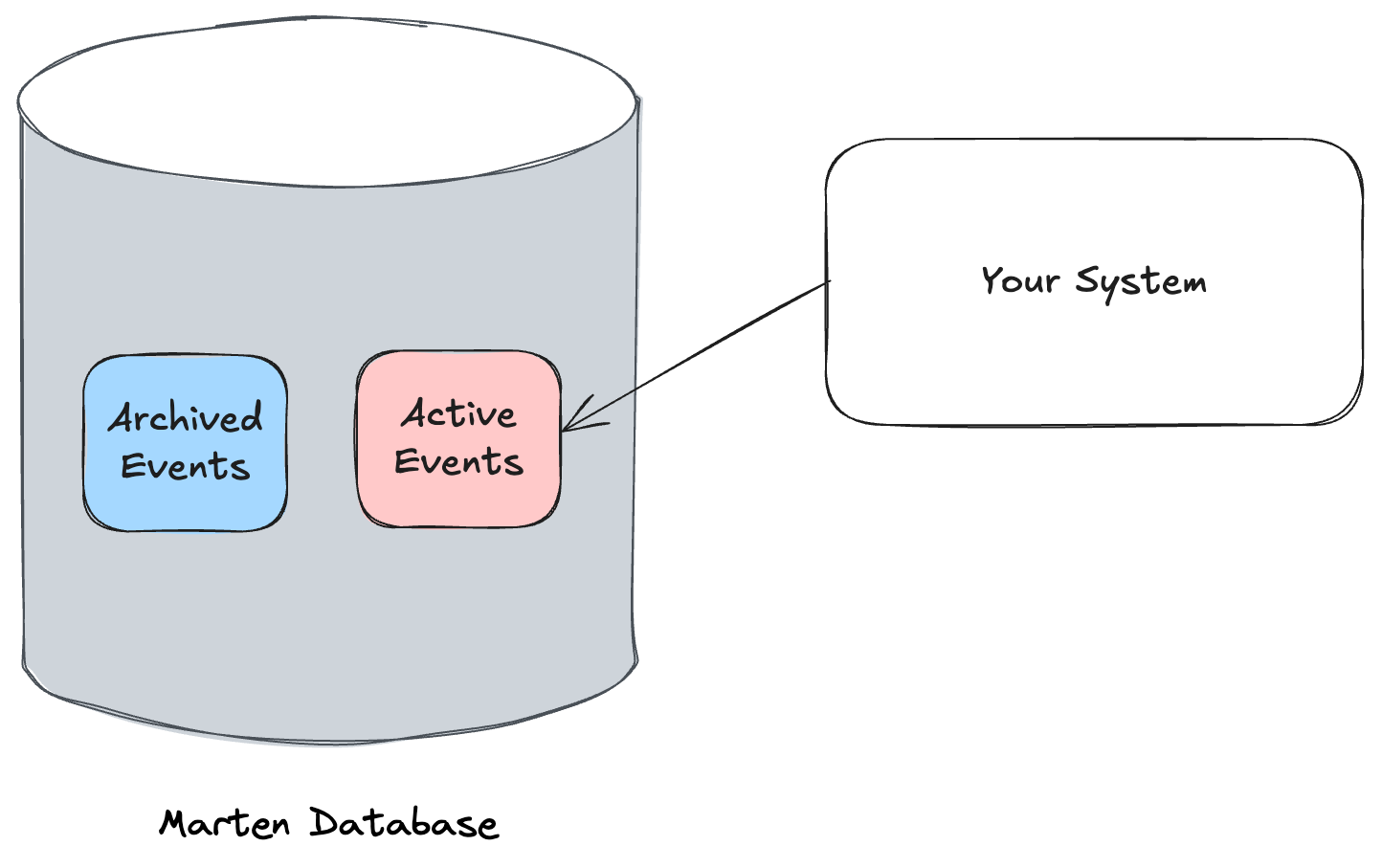
opts.Events.UseArchivedStreamPartitioning = true sets us up for Marten’s “hot/cold” event storage scheme using PostgreSQL native partitioning. More on this in the section on stream archiving below. Read more about this feature in the Marten documentation.
Setting UseIdentityMapForAggregates = true opts into some recent performance optimizations for updating Inline aggregates through Marten’s FetchForWriting API. More detail on this here. Long story short, this makes Marten and Wolverine do less work and make fewer database round trips to support the aggregate handler workflow I’m going to demonstrate below.
Events.AppendMode = EventAppendMode.Quick makes the event appending operations upon saving a Marten session a lot faster, like 50% faster in our testing. It also makes Marten’s “async daemon” feature work smoothly. The downside is that you lose access to some event metadata during Inline projections — which most people won’t care about, but again, we try not to break existing users.
The “Aggregate Handler Workflow”
I have typically described this as Wolverine’s version of the Decider Pattern, but no, I’m now saying that this is a significantly different approach that I believe will lead to better results in larger systems than the “Decider” in that it manages complexity better and handles several technical details that the “Decider” pattern does not. Plus you won’t end up with the humongous switch statements with the Wolverine “Aggregate Handler Workflow” that a Decider function can easily become with any level of domain complexity.
Using Wolverine’s aggregate handler workflow, a command handler that may result in a new event being appended to Marten will look like this one for categorizing an incident:
public static class CategoriseIncidentEndpoint
{
    // This is Wolverine's form of "Railway Programming"
    // Wolverine will execute this before the main endpoint,
    // and stop all processing if the ProblemDetails is *not*
    // "NoProblems"
    public static ProblemDetails Validate(Incident incident)
    {
        return incident.Status == IncidentStatus.Closed
            ? new ProblemDetails { Detail = "Incident is already closed" }

            // All good, keep going!
            : WolverineContinue.NoProblems;
    }

    // This tells Wolverine that the first "return value" is NOT the response
    // body
    [EmptyResponse]
    [WolverinePost("/api/incidents/{incidentId:guid}/category")]
    public static IncidentCategorised Post(
        // the actual command
        CategoriseIncident command,

        // Wolverine is generating code to look up the Incident aggregate
        // data for the event stream with this id
        [Aggregate("incidentId")] Incident incident)
    {
        // This is a simple case where we're just appending a single event to
        // the stream.
        return new IncidentCategorised(incident.Id, command.Category, command.CategorisedBy);
    }
}
The UseIdentityMapForAggregates = true flag optimizes the code above by allowing Marten to use the exact same Incident aggregate object that was originally passed into the Post() method above as the starting basis for updating the Incident data stored in the database. The application of the Inline projection to update the Incident will start with our originally fetched value, apply any new events on top of that, and update the Incident in the same transaction as the events being captured. Without that flag, Marten would have to fetch the Incident starting data from the database all over again when it applies the projection updates while committing the Marten unit of work containing the events.
There’s plenty of rocket science and sophisticated techniques to improving performance, but one simple thing that almost always works out is not repetitively fetching the exact same data from the database if you don’t have to — and that’s the point of the UseIdentityMapForAggregates optimization.
Hot/Cold Storage
Here’s an exciting, relatively new feature in Marten that was planned for years before JasperFx was able to build this for a client late last year. The UseArchivedStreamPartitioning flag sets up your Marten database for “hot / code storage”:
Again, it might require some brain surgery to really improve performance sometimes, but an absolute no-brainer that’s frequently helpful is to just keep your transactional database tables as small and sprightly as possible over time by moving out obsolete or archived data — and that’s exactly what we’re going to do here.
When an Incident event stream is closed, we want to keep that Incident data shown in the user interface for 3 days, then we’d like all the data for that Incident to get archived. Here’s the sample command handler for the CloseIncident command:
public record CloseIncident(
    Guid ClosedBy,
    int Version
);

public static class CloseIncidentEndpoint
{
    [WolverinePost("/api/incidents/close/{id}")]
    public static (UpdatedAggregate, Events, OutgoingMessages) Handle(
        CloseIncident command,
        [Aggregate]
        Incident incident)
    {
        /* More logic for later
        if (current.Status is not IncidentStatus.ResolutionAcknowledgedByCustomer)
               throw new InvalidOperationException("Only incident with acknowledged resolution can be closed");

           if (current.HasOutstandingResponseToCustomer)
               throw new InvalidOperationException("Cannot close incident that has outstanding responses to customer");

         */


        if (incident.Status == IncidentStatus.Closed)
        {
            return (new UpdatedAggregate(), [], []);
        }

        return (

            // Returning the latest view of
            // the Incident as the actual response body
            new UpdatedAggregate(),

            // New event to be appended to the Incident stream
            [new IncidentClosed(command.ClosedBy)],

            // Getting fancy here, telling Wolverine to schedule a
            // command message for three days from now
            [new ArchiveIncident(incident.Id).DelayedFor(3.Days())]);
    }
}
The ArchiveIncident message is being published by this handler using Wolverine’s scheduled message capability so that it will be executed in exactly 3 days time from the current time (you could get fancier and set an exact time to end of business on that day if you wanted).
Note that even when doing the message scheduling, we can still use Wolverine’s cascading message feature. The point of doing this is to keep our handler a pure function that doesn’t have to invoke services, create side effects, or do anything that would force us into asynchronous methods and all of the inherent complexity and noise that inevitably causes.
The ArchiveIncident command handler might just be this:
public record ArchiveIncident(Guid IncidentId);

public static class ArchiveIncidentHandler
{
    // Just going to code this one pretty crudely
    // I'm assuming that we have "auto-transactions"
    // turned on in Wolverine so we don't have to much
    // with the asynchronous IDocumentSession.SaveChangesAsync()
    public static void Handle(ArchiveIncident command, IDocumentSession session)
    {
        session.Events.Append(command.IncidentId, new Archived("It'd done baby!"));
        session.Delete<Incident>(command.IncidentId);
    }
}
When that command executes in three days time, it will delete the projected Incident document from the database and mark the event stream as archived, which will cause PostgreSQL to move that data into the “cold” archived storage.
To close the loop, all normal database operations in Marten specifically filter out archived data with a SQL filter so that they will always be querying directly against the much smaller “active” partition table.
To sum this up, if you use the event archival partitioning and are able to be aggressive about archiving event streams, you can hugely improve the performance of your event sourced application even after you’ve captured a huge number of events because the actual table that Marten is reading and writing from will be relatively stable in side.
As the late, great Stuart Scott would have told us, that’s cooler than the other side of the pillow!
Why aren’t these all defaults?!?
It’s an imperfect world. Every one of the three flags I showed here either subtly change underlying behavior or force additive changes to your application database. The UseIdentityMapForAggregates flag has to be an “opt in” because using that will absolutely give unexpected results for Marten users who mutate the projected aggregate inside of their command handlers (basically anyone doing any type of AggregateRoot base class approach).
Likewise, Marten was originally built using a session with the somewhat more expensive identity map mechanics built in to mimic the commercial tool we were originally trying to replace. I’ve always regretted this decision, but once this has escaped into real systems, changing the underlying behavior absolutely breaks some existing code.
Lastly, introducing the hot/cold partitioning of the event & stream tables to an existing database will cause an expensive database migration, and we certainly don’t want to be inflicting that on unsuspecting users doing an upgrade.
It’s a lot of overhead and compromise, but we’ve chosen to maintain backward compatibility for existing users over enabling out of the box performance improvements.
But wait, there’s more!
Marten has been able to grow quite a bit in capability after I started JasperFx Software as a company to support it. Doing that has allowed us to partner with shops pushing the limits on Marten and Wolverine, and the feedback, collaboration, and yes, compensation has allowed us to push the Critter Stack’s capabilities a lot in the last 18 months.
Sometime in the current quarter, we’re also going to be building and releasing a new “Stream Compacting” feature as another way to deal with archiving data from very long event streams. And yes, a lot of the Event Sourcing community will lecture you about how you should “keep your streams” short, and while there may be some truth to that, that advice is partially around using less capable technical event sourcing solutions. We strive to make Marten & Wolverine more robust so you don’t have to be omniscient and perfect in your upfront modeling.
JasperFx Software already has a strong track record in our short life of helping our customers be more successful using Event Sourcing, Event Driven Architecture, and Test Automation. Much of the content from these new guides came directly out of our client work. We’re certainly ready to partner with your shop as well!
I’ve had a chance the past two weeks to really buckle down and write more tutorials and guides for Wolverine by itself and the full “Critter Stack” combination with Marten. I’ll admit to being a little disappointed by the download numbers on Wolverine right now, but all that really means is that there’s a lot of untapped potential for growth!
If you do any work on the server side with .NET, or are looking for a technical platform to use for event sourcing, event driven architecture, web services, or asynchronous messaging, Wolverine is going to help you build systems that are resilient, easy to change, and highly testable without having to incur the code complexity common to Clean/Onion/Hexagonal Architecture approaches.
Please don’t make a direct comparison of Wolverine to MediatR as a straightforward “Mediator” tool, or to MassTransit or NServiceBus as an Asynchronous Messaging framework, or to MVC Core as a straight up HTTP service framework. Wolverine does far more than any of those other tools to help you write your actual application code.
On to the new guides for Wolverine:
Converting from MediatR – We’re getting more and more questions from users who are coming from MediatR to Wolverine to take advantage of Wolverine capabilities like a transactional outbox that MediatR lacks. Going much further though, this guide tries to explain how to first shift to Wolverine, some important features that Wolverine provides that MediatR does not , and how to lean into Wolverine to make your code a lot simpler and easier to test.
Vertical Slice Architecture – Wolverine has quite a bit of “special sauce” that makes it a unique fit for “Vertical Slice Architecture” (VSA). We believe that Wolverine does more to make a VSA coding style effective than any other server side tooling in the .NET ecosystem. If you haven’t looked at Wolverine recently, you’ll want to check this out because Wolverine just got even more ways to simplify code and improve testability in vertical slices without having to resort to the kind of artifact bloat that’s nearly inevitable with prescriptive Clean/Onion Architecture approaches.
Modular Monolith Architecture – I’ll freely admit that Wolverine was originally optimized for micro-services, and we’ve had to scramble a bit in the recent 3.6.0 release and today’s 3.7.0 release to improve Wolverine’s support for how folks are wanting to do asynchronous workflows between modules in a modular monolith approach. In this guide we’ll talk about how best to use Wolverine for modular monolith architectures, dealing with eventual consistency, database tooling usage, and test automation.
CQRS and Event Sourcing with Marten – Marten is already the most robust and most commonly used toolset for Event Sourcing in the .NET ecosystem. Combined with Wolverine to form the full “Critter Stack,” we think it is one of the most productive toolsets for building resilient and scalable systems using CQRS with Event Sourcing and this guide will show you how the Critter Stack gets that done. There’s also a big section on building integration testing harnesses for the Critter Stack with some of their test support. There are some YouTube videos coming soon that cover this same ground and using some of the same samples.
Railway Programming – Wolverine has some lightweight facilities for “Railway Programming” inside of message handlers or HTTP endpoints that can help code complex workflows with simpler individual steps — and do that without incurring loads of generics and custom “result” types. And for a bonus, this guide even shows you how Wolverine’s Railway Programming usage helps you generate OpenAPI metadata from type signatures without having to clutter up your code with noisy attributes to keep the ReST police off your back.
I personally need a break from writing documentation, but we’ll pop up soon with additional guides for:
Moving from NServiceBus or MassTransit to Wolverine
Wolverine 3.6 just went out tonight as a big release with bug fixes and quite a few significant features to improve Wolverine‘s usability for modular monolith architectures and to further improve Wolverine’s already outstanding usability for vertical slice architecture.
Highlights:
New Persistence Helpers feature to make handlers or http endpoint code event cleaner
The new “Separated” option to better use multiple handlers for the same message type that’s been a source of friction for Wolverine users using modular monolithic approaches to event driven architecture
A huge update to the Message Routing documentation to reflect some new features and existing diagnostics
// Use "Id" as the default member
[WolverinePost("/api/todo/update")]
public static Update<Todo2> Handle(
    // The first argument is always the incoming message
    RenameTodo command,

    // By using this attribute, we're telling Wolverine
    // to load the Todo entity from the configured
    // persistence of the app using a member on the
    // incoming message type
    [Entity] Todo2 todo)
{
    // Do your actual business logic
    todo.Name = command.Name;

    // Tell Wolverine that you want this entity
    // updated in persistence
    return Storage.Update(todo);
}
In the code above, the little method tries to load an entity from the application’s persistence tooling (EF Core, Marten, and RavenDb are supported so far) because of the [Entity] attribute, and the return value of Update<Todo2> will result in the Todo2 entity being updated by the same persistence tooling. That’s arguably an easy method to read and reason about, it was definitely easy to write, it’s easy to unit test, and didn’t require umpteen separate “Clean/Onion Architecture” projects and layers to get to testable code that isn’t directly coupled to infrastructure.
You can contact JasperFx at any time by dropping us an email at sales@jasperfx.net.
2024 was a good year for JasperFx Software LLC for the simple fact that we’ve proven to have an effective business model and some staying power for the future. Along the way, we partnered with clients in eight different countries on two continents deal with a variety of technical challenges through both formal support contracts and consulting contracts.
Besides the obvious focus on our client’s usage of the “Critter Stack” (Marten, Wolverine, and some smaller tools like Alba), we’ve frequently assisted with:
Multi-tenancy strategies, which has run the gamut from multiple databases, multiple message brokers, integration within applications, to simply finding ways to reduce downtime necessary to add new tenants
Scaling and performance, especially with event sourcing
Concurrency issues of all kinds
Creating effective test automation strategies, both in terms of how to create testable code for efficient unit testing and helping bootstrap integration testing approaches
Dealing with technical debt and formulating plans for application modernization
Underpinning all of that is assisting with any number of issues that arise from our client’s usage of Event Sourcing or Event Driven Architecture approaches as those are still relatively new to our industry and many developers are not yet experienced with these approaches.
If you have any concerns about your server side .NET architecture or systems, need help with your usage of Event Sourcing, Event Driven Architecture, or Test Driven Development and other Test Automation strategies, JasperFx Software is ready to help. And of course, we’re the home of the “Critter Stack” tools that provide the strongest and most feature rich support for Event Sourcing in the .NET ecosystem and provide formal, ongoing support plans for these tools.
In 2025 our goal as a company is to grow in revenue and in size to better serve our support customers and stay on top of our ever increasing technical toolset. We’re still keenly focused on delivering the long discussed “Critter Watch” tooling as our first commercial product to serve as a global management console and correlated production monitoring tool for Critter Stack applications. A secondary goal is to increase the reach of the “Critter Stack” tooling, especially the Event Sourcing functionality, to additional database technologies.
And of course, JasperFx Software is available for any kind of consulting engagement around the Critter Stack tools, event sourcing, event driven architecture, test automation, or just any kind of server side .NET architecture.
Absurdly enough, the Marten community made one major release (7.0 was a big change) and 35 different releases of new functionality. Some significant, some just including a new tactical convenience method or two. I think Marten ends the 2024 calendar year with the 7.35.0 release today.
The big highlight is some work for a JasperFx Software client who needs to run some multi-stream projections asynchronously (as one probably should), but needs their user interface client in some scenarios to be showing the very latest information. That’s now possible with the QueryForNonStaleData<T>()` API shown below:
var builder = Host.CreateApplicationBuilder();
builder.Services.AddMarten(opts =>
{
    opts.Connection(builder.Configuration.GetConnectionString("marten"));
    opts.Projections.Add<TripProjection>(ProjectionLifecycle.Async);
}).AddAsyncDaemon(DaemonMode.HotCold);

using var host = builder.Build();
await host.StartAsync();

// DocumentStore() is an extension method in Marten just
// as a convenience method for test automation
await using var session = host.DocumentStore().LightweightSession();

// This query operation will first "wait" for the asynchronous projection building the
// Trip aggregate document to catch up to at least the highest event sequence number assigned
// at the time this method is called
var latest = await session.QueryForNonStaleData<Trip>(5.Seconds())
    .OrderByDescending(x => x.Started)
    .Take(10)
    .ToListAsync();
Of course, there is a non-zero risk of that operation timing out, so it’s not a silver bullet and you’ll need to be aware of that in your usage, but hey, it’s a way around needing to adopt eventual consistency while also providing a good user experience in your client by not appearing to have lost data.
The highlight for me personally is that as of this second, the open issue count for Marten on GitHub is sitting at 37 (bugs, enhancement requests, 8.0 planning, documentation TODOs), which is the lowest that number has been for 7/8 years. Feels good.
Through a combination of Marten community members and in collaboration with some JasperFx Software clients, we’re able to push some new fixes and functionality in Marten 7.34 just today.
For the F# Person in your Life
You can now use F# Option types in LINQ Where() clauses in Marten. Check out the pull request for that to see samples. The LINQ provider code is just a difficult problem domain, and I can’t tell you how grateful I am to have gotten the community pull request for this.
Fetch the Latest Aggregate
Marten has had the FetchForWriting() API for awhile now as our recommended way to build CQRS command handlers with Marten event sourcing as I wrote about recently in CQRS Command Handlers with Marten. Great, but…
What if you just want a read only view of the current data for an aggregate projection over a single event stream and wouldn’t mind a lighter weight API than FetchForWriting()?
What if in your command handler you used FetchForWriting(), but now you want to return the now updated version of your aggregate projection for the caller of the command? And by the way, you want this to be as performant as possible no matter how the projection is configured.
Now you’re in luck, because Marten 7.34 adds the new FetchLatest() API for both of the bullets above.
Let’s pretend we’re building an invoicing system with Marten event sourcing and have this “self-aggregating” version of an Invoice:
public record InvoiceCreated(string Description, decimal Amount);

public record InvoiceApproved;
public record InvoiceCancelled;
public record InvoicePaid;
public record InvoiceRejected;

public class Invoice
{
    public Invoice()
    {
    }

    public static Invoice Create(IEvent<InvoiceCreated> created)
    {
        return new Invoice
        {
            Amount = created.Data.Amount,
            Description = created.Data.Description,

            // Capture the timestamp from the event
            // metadata captured by Marten
            Created = created.Timestamp,
            Status = InvoiceStatus.Created
        };
    }

    public int Version { get; set; }

    public decimal Amount { get; set; }
    public string Description { get; set; }
    public Guid Id { get; set; }
    public DateTimeOffset Created { get; set; }
    public InvoiceStatus Status { get; set; }

    public void Apply(InvoiceCancelled _) => Status = InvoiceStatus.Cancelled;
    public void Apply(InvoiceRejected _) => Status = InvoiceStatus.Rejected;
    public void Apply(InvoicePaid _) => Status = InvoiceStatus.Paid;
    public void Apply(InvoiceApproved _) => Status = InvoiceStatus.Approved;
}
And for now, we’re going to let our command handlers just use a Live aggregation of the Invoice from the raw events on demand:
var builder = Host.CreateApplicationBuilder();
builder.Services.AddMarten(opts =>
{
    opts.Connection(builder.Configuration.GetConnectionString("marten"));

    // Just telling Marten upfront that we will use
    // live aggregation for the Invoice aggregate
    // This would be the default anyway if you didn't explicitly
    // register Invoice this way, but doing so let's
    // Marten "know" about Invoice for code generation
    opts.Projections.LiveStreamAggregation<Projections.Invoice>();
});
Now we can get at the latest, greatest, current view of the Invoice that is consistent with the captured events for that invoice stream at this very moment with this usage:
public static async Task read_latest(
    // Watch this, only available on the full IDocumentSession
    IDocumentSession session,
    Guid invoiceId)
{
    var invoice = await session
        .Events.FetchLatest<Projections.Invoice>(invoiceId);
}
The usage of the API above would be completely unchanged if you were to switch the projection lifecycle of the Invoice to be either Inline (where the view is updated in the database at the same time new events are captured) or Async. That usage gives you a little bit of what we called “reversibility” in the XP days, which just means that you’re easily able to change your mind later about exactly what projection lifecycle you want to use for Invoice views.
The main reason that FetchLatest() was envisioned, however, was to pair up with FetchForWriting() in command handlers. It’s turned out to be a common use case that folks want their command handlers to:
Use the current state of the projected aggregate for the event stream to…
“Decide” what new events should be appended to this stream based on the incoming command and existing state of the aggregate
Save the changes
Return a now updated version of the projected aggregate for the event stream with the newly captured events reflected in the projected aggregate.
There is going to be a slicker integration of this with Wolverine’s aggregate handler workflow with Marten by early next week, but for now, let’s pretend we’re working with Marten from within maybe ASP.Net Minimal API and want to just work that way. Let’s say that we have a little helper method for a mini-“Decider” pattern implementation for our Invoice event streams like this one:
public static class MutationExtensions
{
    public static async Task<Projections.Invoice> MutateInvoice(this IDocumentSession session, Guid id, Func<Projections.Invoice, IEnumerable<object>> decider,
        CancellationToken token = default)
    {
        var stream = await session.Events.FetchForWriting<Projections.Invoice>(id, token);

        // Decide what new events should be appended based on the current
        // state of the aggregate and application logic
        var events = decider(stream.Aggregate);
        stream.AppendMany(events);

        // Persist any new events
        await session.SaveChangesAsync(token);

        return await session.Events.FetchLatest<Projections.Invoice>(id, token);
    }
}
Which could be used something like:
public static Task Approve(IDocumentSession session, Guid invoiceId)
{
    // I'd maybe suggest taking the lambda being passed in
    // here out somewhere where it's easy to test
    // Wolverine does that for you, so maybe just use that!
    return session.MutateInvoice(invoiceId, invoice =>
    {
        if (invoice.Status != InvoiceStatus.Approved)
        {
            return [new InvoiceApproved()];
        }

        return [];
    });
}
New Marten System Level “Archived” Event
Much more on this soon with an example more end to end with Wolverine explaining how this would add value for performance and testability.
Marten now has a built in event named Archived that can be appended to any event stream:
namespace Marten.Events;

/// <summary>
/// The presence of this event marks a stream as "archived" when it is processed
/// by a single stream projection of any sort
/// </summary>
public record Archived(string Reason);
When this event is appended to an event stream and that event is processed through any type of single stream projection for that event stream (snapshot or what we used to call a “self-aggregate”, SingleStreamProjection, or CustomProjection with the AggregateByStream option), Marten will automatically mark that entire event stream as archived as part of processing the projection. This applies for both Inline and Async execution of projections.
Let’s try to make this concrete by building a simple order processing system that might include this aggregate:
public class Item
{
    public string Name { get; set; }
    public bool Ready { get; set; }
}

public class Order
{
    // This would be the stream id
    public Guid Id { get; set; }

    // This is important, by Marten convention this would
    // be the
    public int Version { get; set; }

    public Order(OrderCreated created)
    {
        foreach (var item in created.Items)
        {
            Items[item.Name] = item;
        }
    }

    public void Apply(IEvent<OrderShipped> shipped) => Shipped = shipped.Timestamp;
    public void Apply(ItemReady ready) => Items[ready.Name].Ready = true;

    public DateTimeOffset? Shipped { get; private set; }

    public Dictionary<string, Item> Items { get; set; } = new();

    public bool IsReadyToShip()
    {
        return Shipped == null && Items.Values.All(x => x.Ready);
    }
}
Next, let’s say we’re having the Order aggregate snapshotted so that it’s updated every time new events are captured like so:
var builder = Host.CreateApplicationBuilder();
builder.Services.AddMarten(opts =>
{
    opts.Connection("some connection string");

    // The Order aggregate is updated Inline inside the
    // same transaction as the events being appended
    opts.Projections.Snapshot<Order>(SnapshotLifecycle.Inline);

    // Opt into an optimization for the inline aggregates
    // used with FetchForWriting()
    opts.Projections.UseIdentityMapForAggregates = true;
})

// This is also a performance optimization in Marten to disable the
// identity map tracking overall in Marten sessions if you don't
// need that tracking at runtime
.UseLightweightSessions();
Now, let’s say as a way to keep our application performing as well as possible, we’d like to be aggressive about archiving shipped orders to keep the “hot” event storage table small. One way we can do that is to append the Archived event as part of processing a command to ship an order like so:
public static async Task HandleAsync(ShipOrder command, IDocumentSession session)
{
    var stream = await session.Events.FetchForWriting<Order>(command.OrderId);
    var order = stream.Aggregate;

    if (!order.Shipped.HasValue)
    {
        // Mark it as shipped
        stream.AppendOne(new OrderShipped());

        // But also, the order is done, so let's mark it as archived too!
        stream.AppendOne(new Archived("Shipped"));

        await session.SaveChangesAsync();
    }
}
If an Order hasn’t already shipped, one of the outcomes of that command handler executing is that the entire event stream for the Order will be marked as archived.
JasperFx Software has gotten the chance this work to build out several strategic improvements to both Marten and Wolverine through collaborations with our clients who have had some specific needs. This has been highly advantageous because it’s helped push some significant, long planned technical improvements while getting all important feedback as clients integrate the new features. Today I’d like to throw out a couple valuable features and capabilities that Marten has gained as part of recent client work.
“Side Effects” in Projections
In a recent post called Multi Step Workflows with the Critter Stack I talked about using Wolverine sagas (really process managers if you have to be precise about the pattern name because I’m slopping about interchanging “saga” and “process manager”) for long running workflows. In that post I talked about how an incoming file would be:
Broken up into batches of rows
Each batch would be validated as a separately handled message for some parallelization and more granular retries
When there were validation results recorded for each record batch, the file processing itself would either stop with a call back message summarizing the failures to the upstream sender or continue to the next stage.
As it turns out, event sourcing with a projected aggregate document for the state of the file import turns out to be another good way to implement this workflow, especially with the new “side effects” model recently introduced in Marten at the behest of a JasperFx client.
In this usage. let’s say that we have this aggregated state for a file being imported:
public class FileImportState
{

    // Identity for this saga within our system
    public Guid Id { get; set; }
    public string FileName { get; set; }
    public string PartnerTrackingNumber { get; set; }
    public DateTimeOffset Created { get; set; } = DateTimeOffset.UtcNow;
    public List<RecordBatchTracker> RecordBatches { get; set; } = new();

    public FileImportStage Stage { get; set; } = FileImportStage.Validating;
}
The FileImportState would be updated by appending events like BatchValidated, with Marten “projecting” those events in the rolled up state of the entire file. In Marten’s async daemon process that runs projections in a background process, Marten is processing a certain range (think events 10000 to 11000) at a time. As the daemon processes events into a projection for the FileImportState, it’s grouping the events in that range into event “slices” that are grouped by file id.
For managing the workflow, we can now append all new events as a “side effect” of processing an event slice in the daemon as the aggregation data is updated in the background. Let’s say that we have a single stream projection for our FileImportState aggregation like this below:
public class FileImportProjection : SingleStreamProjection<FileImportState>
{
    // Other Apply / Create methods to update the state of the
    // FileImportState aggregate document

    public override ValueTask RaiseSideEffects(IDocumentOperations operations, IEventSlice<FileImportState> slice)
    {
        var state = slice.Aggregate;
        if (state.Stage == FileImportStage.Validating &&
            state.RecordBatches.All(x => x.ValidationStatus != RecordStatus.Pending))
        {
            // At this point, the file is completely validated, and we can decide what should happen next with the
            // file

            // Are there any validation message failures?
            var rejected = state.RecordBatches.SelectMany(x => x.ValidationMessages).ToArray();
            if (rejected.Any())
            {
                // Append a validation failed event to the stream
                slice.AppendEvent(new ValidationFailed());

                // Also, send an outgoing command message that summarizes
                // the validation failures
                var message = new FileRejectionSummary()
                {
                    FileName = state.FileName,
                    Messages = rejected,
                    TrackingNumber = state.PartnerTrackingNumber
                };

                // This will "publish" a message once the daemon
                // has successfully committed all changes for the
                // current batch of events
                // Unsurprisingly, there's a Wolverine integration
                // for this
                slice.PublishMessage(message);
            }
            else
            {
                slice.AppendEvent(new ValidationSucceeded());
            }
        }

        return new ValueTask();
    }
}
And unsurprisingly, there is also the ability to “publish” outgoing messages as part of processing through asynchronous projections with an integration to Wolverine available.
This feature has long, long been planned and I was glad to get the chance to build it out this fall for a client. I’m happy to say that this is in production for them — after the obligatory shakedown cruise and some bug fixes.
Optimized Projection Rebuilds
Another JasperFx client has a system where they retrofitted Marten into an in flight system using event sourcing for a very large data set, but didn’t take advantage of many Marten capabilities including the ability to effectively pre-build or “snapshot” projected data to optimize system state reads.
With a little bit of work in their system, we knew we would be able to introduce the new projection snapshotting into their system with Marten’s blue/green deployment model for projections where Marten would immediately start trying to pre-build a new projection (or new version of an existing projection) from scratch. Great! Except we knew that was potentially going to be a major performance problem until the projection caught up to the current “high water mark” of the event store.
To ease the cost of introducing a new, persisted projection on top of ~100 million events, we built out Marten’s new optimized projection rebuild feature. To demonstrate what I mean, let’s first opt into using this feature (it had to be opt in because it forces users to made additive changes to existing database tables):
builder.Services.AddMarten(opts =>
{
    opts.Connection("some connection string");

    // Opts into a mode where Marten is able to rebuild single
    // stream projections faster by building one stream at a time
    // Does require new table migrations for Marten 7 users though
    opts.Events.UseOptimizedProjectionRebuilds = true;
});
Now, when our users redeploy their system with the new snapshotted projection running with Marten’s Async workflow for the first time Marten will see that the projection has not been processed before, so will try to use an “optimized rebuild mode.” Since we’ve turned on optimized projection rebuilds, for a single stream projection, Marten runs the projection in “rebuild” mode by:
First building a new table to track each event stream that relates to the aggregate type in question, but builds this table in reverse order of when each stream has been changed. The whole point of that is to make sure our optimized rebuild process is dealing with the most recently changed event streams so that the system can perform well even while the rebuild process in running
The rebuild process rebuilds the aggregates event stream by event stream as a way of minimizing the number of database reads and writes it takes to rebuild the single stream projection. Compare that to the previous, naive “left fold” approach where it just works from event sequence = 1 to the high water mark and constantly writes and reads back the same projection document as its encountered throughout the event store
When the optimized rebuild is complete, it switches the projection to running in its normal, continuous mode from the point at which the rebuild started
That’s a lot of words and maybe some complicated explanation, but the point is that Marten makes it possible to introduce new projections to a large, in flight system without incurring system downtime or even inconsistent data showing up to users.
Other Recent Improvements for Clients
Some other recent work that JasperFx has done for our clients includes:
I was part of a discussion slash argument a couple weeks ago about whether or not it was necessary to use an off the shelf event sourcing library or framework like Marten, or if you were just fine rolling your own. While I’d gladly admit that you can easily build purely a storage subsystem for events, it’s not even remotely feasible to quickly roll your own tooling that matches advanced features in Marten such as the work I presented here.
The new feature shown in this post was built by JasperFx Software as part of a client engagement. This is exactly the kind of novel or challenging issue we frequently help our clients solve. If there’s something in your shop’s ongoing efforts where you could use some extra technical help, reach out to sales@jasperfx.net and we’ll be happy to talk with you.
Wolverine 3.4 was released today with a large new feature for multi-tenancy through asynchronous messaging. This feature set was envisioned for usage in an IoT system using the full “Critter Stack” (Marten and Wolverine) where “our system” is centralized in the cloud, but has to communicate asynchronously with physical devices deployed at different client sites:
The system in question already uses Marten’s support for separating per tenant information into separate PostgreSQL databases. Wolverine itself works with Marten’s multi-tenancy to make that a seamless process within Wolverine messaging workflows. All of that arguably quite robust already support was envisioned to be running within either HTTP web services or asynchronous messaging workflows completely controlled by the deployed application and its peer services. What’s new with Wolverine 3.4 is the ability to isolate the communication with remote client (tenant) devices and the centralized, cloud deployed “our system.”
We can isolate the traffic between each client site and our system first by using a separate Rabbit MQ broker or at least a separate virtual host per tenant as implied in the code sample from the docs below:
var builder = Host.CreateApplicationBuilder();

builder.UseWolverine(opts =>
{
    // At this point, you still have to have a *default* broker connection to be used for
    // messaging.
    opts.UseRabbitMq(new Uri(builder.Configuration.GetConnectionString("main")))

        // This will be respected across *all* the tenant specific
        // virtual hosts and separate broker connections
        .AutoProvision()

        // This is the default, if there is no tenant id on an outgoing message,
        // use the default broker
        .TenantIdBehavior(TenantedIdBehavior.FallbackToDefault)

        // Or tell Wolverine instead to just quietly ignore messages sent
        // to unrecognized tenant ids
        .TenantIdBehavior(TenantedIdBehavior.IgnoreUnknownTenants)

        // Or be draconian and make Wolverine assert and throw an exception
        // if an outgoing message does not have a tenant id
        .TenantIdBehavior(TenantedIdBehavior.TenantIdRequired)

        // Add specific tenants for separate virtual host names
        // on the same broker as the default connection
        .AddTenant("one", "vh1")
        .AddTenant("two", "vh2")
        .AddTenant("three", "vh3")

        // Or, you can add a broker connection to something completel
        // different for a tenant
        .AddTenant("four", new Uri(builder.Configuration.GetConnectionString("rabbit_four")));

    // This Wolverine application would be listening to a queue
    // named "incoming" on all virtual hosts and/or tenant specific message
    // brokers
    opts.ListenToRabbitQueue("incoming");

    opts.ListenToRabbitQueue("incoming_global")

        // This opts this queue out from being per-tenant, such that
        // there will only be the single "incoming_global" queue for the default
        // broker connection
        .GlobalListener();

    // More on this in the docs....
    opts.PublishMessage<Message1>()
        .ToRabbitQueue("outgoing").GlobalSender();
});
With this solution, we now have a “global” Rabbit MQ broker we can use for all internal communication or queueing within “our system”, and a separate Rabbit MQ virtual host for each tenant. At runtime, when a message tagged with a tenant id is published out of “our system” to a “per tenant” queue or exchange, Wolverine is able to route it to the correct virtual host for that tenant id. Likewise, Wolverine is listening to the queue named “incoming” on each virtual host (plus the global one), and automatically tags messages coming from the per tenant virtual host queues with the correct tenant id to facilitate the full Marten/Wolverine workflow downstream as the incoming messages are handled.
Now, let’s switch it up and use Azure Service Bus instead to basically do the same thing. This time though, we can register additional tenants to use a separate Azure Service Bus fully qualified namespace or connection string:
var builder = Host.CreateApplicationBuilder();

builder.UseWolverine(opts =>
{
    // One way or another, you're probably pulling the Azure Service Bus
    // connection string out of configuration
    var azureServiceBusConnectionString = builder
        .Configuration
        .GetConnectionString("azure-service-bus");

    // Connect to the broker in the simplest possible way
    opts.UseAzureServiceBus(azureServiceBusConnectionString)

        // This is the default, if there is no tenant id on an outgoing message,
        // use the default broker
        .TenantIdBehavior(TenantedIdBehavior.FallbackToDefault)

        // Or tell Wolverine instead to just quietly ignore messages sent
        // to unrecognized tenant ids
        .TenantIdBehavior(TenantedIdBehavior.IgnoreUnknownTenants)

        // Or be draconian and make Wolverine assert and throw an exception
        // if an outgoing message does not have a tenant id
        .TenantIdBehavior(TenantedIdBehavior.TenantIdRequired)

        // Add new tenants by registering the tenant id and a separate fully qualified namespace
        // to a different Azure Service Bus connection
        .AddTenantByNamespace("one", builder.Configuration.GetValue<string>("asb_ns_one"))
        .AddTenantByNamespace("two", builder.Configuration.GetValue<string>("asb_ns_two"))
        .AddTenantByNamespace("three", builder.Configuration.GetValue<string>("asb_ns_three"))

        // OR, instead, add tenants by registering the tenant id and a separate connection string
        // to a different Azure Service Bus connection
        .AddTenantByConnectionString("four", builder.Configuration.GetConnectionString("asb_four"))
        .AddTenantByConnectionString("five", builder.Configuration.GetConnectionString("asb_five"))
        .AddTenantByConnectionString("six", builder.Configuration.GetConnectionString("asb_six"));

    // This Wolverine application would be listening to a queue
    // named "incoming" on all Azure Service Bus connections, including the default
    opts.ListenToAzureServiceBusQueue("incoming");

    // This Wolverine application would listen to a single queue
    // at the default connection regardless of tenant
    opts.ListenToAzureServiceBusQueue("incoming_global")
        .GlobalListener();

    // Likewise, you can override the queue, subscription, and topic behavior
    // to be "global" for all tenants with this syntax:
    opts.PublishMessage<Message1>()
        .ToAzureServiceBusQueue("message1")
        .GlobalSender();

    opts.PublishMessage<Message2>()
        .ToAzureServiceBusTopic("message2")
        .GlobalSender();
});
This is a lot to take in, but the major point is to keep client messages completely separate from each other while also enabling the seamless usage of multi-tenanted workflows all the way through the Wolverine & Marten pipeline. As we deal with the inevitable teething pains, the hope is that the behavioral code within the Wolverine message handlers never has to be concerned with any kind of per-tenant bookkeeping. For more information, see:
And as I typed all of that out, I do fully realize that there would be some value in having a comprehensive “Multi-Tenancy with the Critter Stack” guide in one place.
Summary
I honestly don’t know if this feature set gets a lot of usage, but it came out of what’s been a very productive collaboration with JasperFx’s original customer as we’ve worked together on their IoT system. Quite a bit of improvements to Wolverine have come about as a direct reaction to friction or opportunities that we’ve spotted with our collaboration.
As far as multi-tenancy goes, I think the challenges for the Critter Stack toolset has been to give our users all the power they need to keep data and now messaging completely separate across tenants while relentlessly removing repetitive code ceremony or usability issues. My personal philosophy is that lower ceremony code is an important enabler of successful software development efforts over time.
“Lightweight” just meaning “it doesn’t have a lot of features yet”
To get started, first add this Nuget to your system:
dotnet add WolverineFx.Pulsar
And just like that, you’re ready to start adding publishing rules and subscriptions to Pulsar topics in a very idiomatic Wolverine way:
var builder = Host.CreateApplicationBuilder();
builder.UseWolverine(opts =>
{
    opts.UsePulsar(c =>
    {
        var pulsarUri = builder.Configuration.GetValue<Uri>("pulsar");
        c.ServiceUrl(pulsarUri);

        // Any other configuration you want to apply to your
        // Pulsar client
    });

    // Publish messages to a particular Pulsar topic
    opts.PublishMessage<Message1>()
        .ToPulsarTopic("persistent://public/default/one")

        // And all the normal Wolverine options...
        .SendInline();

    // Listen for incoming messages from a Pulsar topic
    opts.ListenToPulsarTopic("persistent://public/default/two")

        // And all the normal Wolverine options...
        .Sequential();
});
It’s a minimal implementation for right now (no conventional routing topology for example), but we’ll happily enhance this transport option if there’s interest. To be honest, the Pulsar transport has been hanging out inside the Wolverine codebase for years, but never got released for whatever reason. Someone asked about this awhile back, so here we go!
Assuming that the US still exists tomorrow and I’m not trying to move my family to Canada, I’ll follow up with Wolverine’s new, fully robust transport option for Google Pubsub.










 The Shade Tree Developer