Conventional Message Routing in Wolverine

I got a little feedback over the weekend that some folks newly encountering Wolverine for the first time think that it’s harder to use than some other tools because “it doesn’t do the message routing for you.” This fortunately isn’t true, but there’s obviously some work to do on improving documentation and samples to dispel that impression.

For the sake of this post, let’s assume that you want to use Wolverine for asynchronous messaging between processes using an external messaging broker transport (or using asynchronous messaging in a single application but queueing up work in an external message broker). And while Wolverine does indeed have support for interoperability with non-Wolverine applications, let’s assume that it’s going to be Wolverine on both sides of all the message pipes.

First though, just know that for all for external transports with Wolverine, the conventional routing is opt in, meaning that you have to explicitly turn it on when you configure Wolverine within the UseWolverine() bootstrapping. Likewise, know that you can also control exactly how Wolverine configures the listening or message sending behavior in the conventionally determined endpoints.

Now then, to just go fast and make Wolverine do all the message routing for you with predictable conventions “just” see these recipes:

For Wolverine’s Rabbit MQ integration, you can opt into conventional routing like this:

        using var host = await Host.CreateDefaultBuilder()
            .UseWolverine(opts =>
            {
                opts.UseRabbitMq()
                    // Opt into conventional Rabbit MQ routing
                    .UseConventionalRouting();
            }).StartAsync();

In this convention, message routing is to:

  1. Publish all messages to a Rabbit MQ exchange named after Wolverine’s message type name that’s effectively the alias for that message type. Most of the time that’s just the full name of the concrete .NET type.
  2. Create a Rabbit MQ queue named with Wolverine’s message type name for the message type of every known message handler within your application. Wolverine also configures a binding from a Rabbit MQ exchange with that same name to the Rabbit MQ queue for that message type.

This routing behavior was absolutely influenced by similar functionality in the older MassTransit framework. Imitation is the sincerest form of flattery, plus I just agree with what they did anyway. Wolverine adds additional value through its richer resource setup model (AutoProvision / AddResourceSetupOnStartup()) and stronger model of automatic handler discovery.

That’s the quickest possible way to get started, but you have plenty of other levers, knobs, and dials to farther control the conventions as shown below:

        using var host = await Host.CreateDefaultBuilder()
            .UseWolverine(opts =>
            {
                opts.UseRabbitMq()
                    // Opt into conventional Rabbit MQ routing
                    .UseConventionalRouting(c =>
                    {
                        // Override naming conventions
                        c.QueueNameForListener(type => type.Name);
                        c.ExchangeNameForSending(type => type.Name);

                        // Override the configuration for each listener
                        c.ConfigureListeners((l, _) =>
                        {
                            l.ProcessInline().ListenerCount(5);
                        });

                        // Override the sending configuration for each subscriber
                        c.ConfigureSending((s, _) =>
                        {
                            s.UseDurableOutbox();
                        });
                    })
                    
                    // Let Wolverine both discover all these necessary exchanges, queues,
                    // and binding, then also build them as necessary on the broker if
                    // they are missing
                    .AutoProvision();
            }).StartAsync();

The “extra” optional configuration I used above hopefully show you how to take more exacting control over the conventional routing, but the pure defaults in the first sample will help you get up and going fast.

Let’s move on.

Azure Service Bus

Wolverine’s Azure Service Bus integration comes with a pair of conventional routing options. The simpler is to let Wolverine create and utilize an Azure Service Bus queue named after each message type name for both sending the receiving with this syntax:

        using var host = await Host.CreateDefaultBuilder()
            .UseWolverine(opts =>
            {
                opts.UseAzureServiceBus("some connection string")
                    .UseConventionalRouting();
            }).StartAsync();

Slightly more complicated is another option to use Azure Service Bus topics and subscriptions like so:

    // opts is a WolverineOptions object    
    opts.UseAzureServiceBusTesting()
                
        .UseTopicAndSubscriptionConventionalRouting(convention =>
                {
                    // Optionally control every aspect of the convention and
                    // its applicability to types
                    // as well as overriding any listener, sender, topic, or subscription
                    // options
                });

In this usage:

  1. Outgoing messages are routed to an Azure Service Bus topic named after Wolverine’s message type name for that type
  2. At application startup, Wolverine will listen for an Azure Service Bus subscription for each message type from the application’s known message handlers. Likewise, that subscription will automatically be bound to a topic named after the message type name

As was the case with the Rabbit MQ conventions shown first, you have complete control over the naming conventions, the listener configuration, and the subscriber configuration.

For Wolverine’s AWS SQS integration, you can conventionally route to SQS queues named after Wolverine’s message type name (by default) like this:

        var host = await Host.CreateDefaultBuilder()
            .UseWolverine(opts =>
            {
                opts.UseAmazonSqsTransport()
                    .UseConventionalRouting();

            }).StartAsync();

As was the case with the Rabbit MQ conventions shown first, you have complete control over the naming conventions, the listener configuration, and the subscriber configuration.

Wolverine’s Kafka integration is a little bit different animal. In this case you can set up rules to publish to different Kafka topics by message type like this:

        using var host = await Host.CreateDefaultBuilder()
            .UseWolverine(opts =>
            {
                opts.UseKafka("localhost:29092").AutoProvision();

                opts.PublishAllMessages().ToKafkaTopics();

                opts.Services.AddResourceSetupOnStartup();
            }).StartAsync();

In this case, Wolverine will send each message type to a topic name derived from the message type that’s either Wolverine’s message type name or an explicitly configured topic name configured by attribute like:

[Topic("color.purple")]
public class PurpleMessage
{
}

What if I want a completely different routing convention?!?

There’s an extension point for programmatic message routing rules in Wolverine that’s utilized by all the capabilities shown above called IMessageRouteSource, but if you think you really want to use that, maybe just head to the Wolverine Discord room and we’ll try to help you out!

Summary

Wolverine has strong support for conventional message routing using external brokers, but you need to make at least a one line of code entry in your configuration to explicitly add this behavior to your system. In all cases, Wolverine is able to help build the necessary queues, topics, subscriptions, binding, and exchanges derived by these conventions in your message broker for an efficient developer experience. Moreover, you have complete power to fine tune the usage of this conventional routing for your application.

Recent Critter Stack Multi-Tenancy Improvements

Hey, did you know that JasperFx Software offers formal support plans for Marten and Wolverine? Not only are we making the “Critter Stack” tools be viable long term options for your shop, we’re also interested in hearing your opinions about the tools and how they should change. We’re also certainly open to help you succeed with your software development projects on a consulting basis whether you’re using any part of the Critter Stack or some completely different .NET server side tooling.

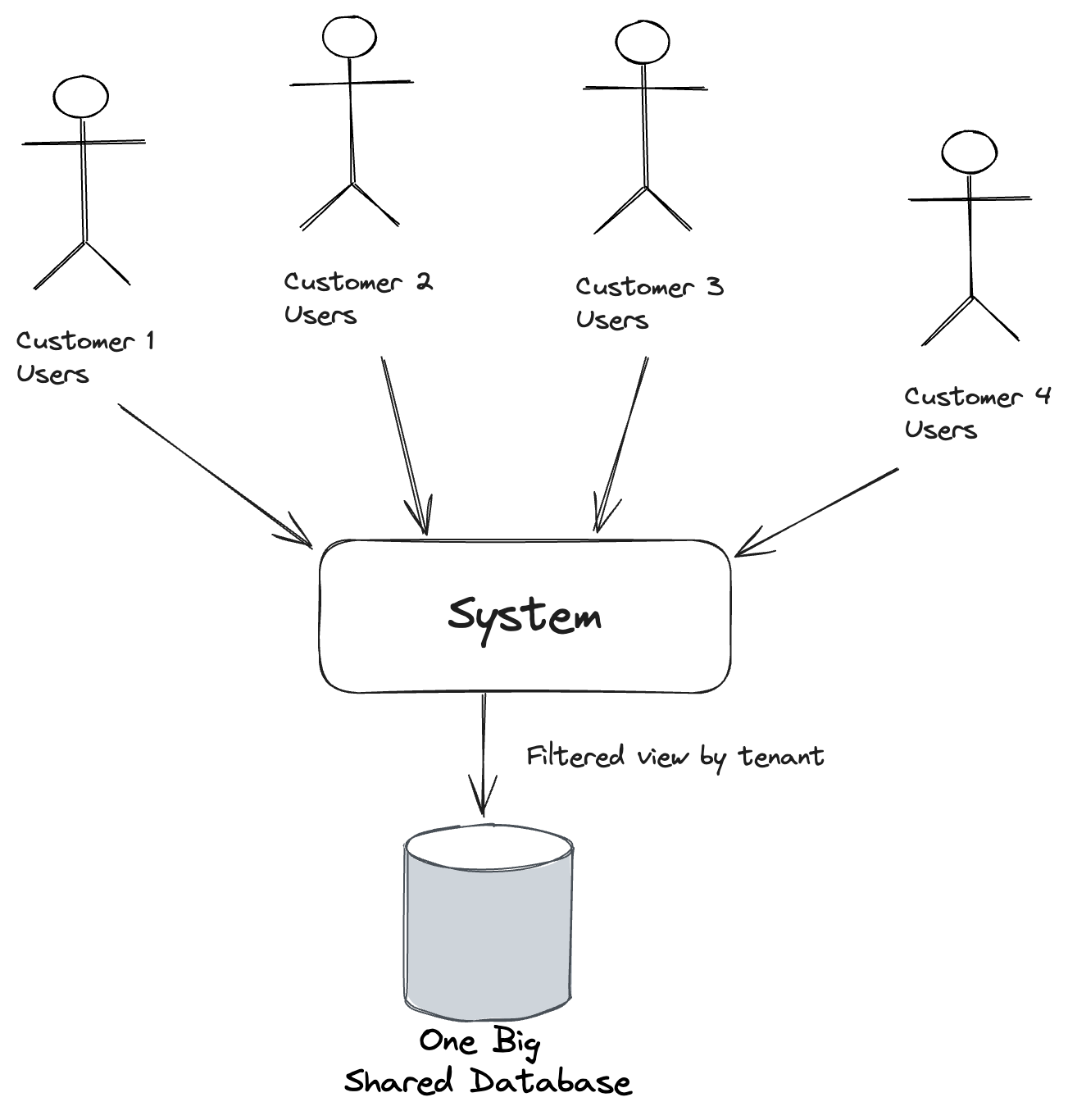
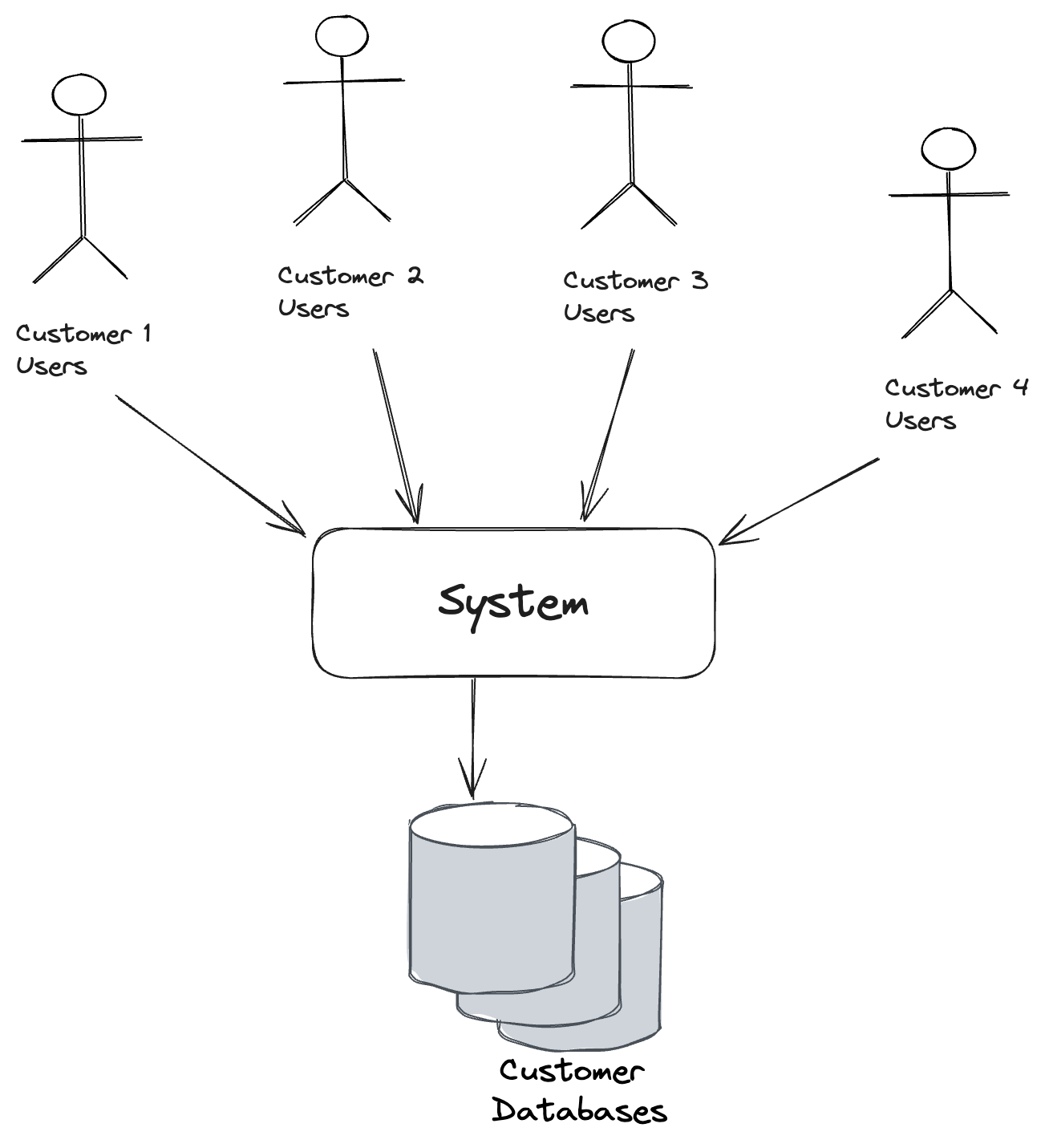
Marten 7.0 was released over the weekend, and Wolverine 2.0 followed yesterday mostly to catch up with the Marten dependency. One of the major improvements in this round of “Critter Stack” releases was to address a JasperFx client’s need for dynamically adding new tenant databases at runtime without having to do any kind of system deployment.

Doing that successfully meant adding a couple capabilities throughout the “Critter Stack.” First off, Marten needed a new multi-tenancy configuration strategy that allowed users to keep a list of valid tenant id and database connection strings for those tenants in a database table. Enter Marten 7’s new Master Table Tenancy Model. You can see the usage in this sample from the documentation:

using var host = await Host.CreateDefaultBuilder()
    .ConfigureServices(services =>
    {
        services.AddMarten(sp =>
            {
                var configuration = sp.GetRequiredService<IConfiguration>();
                var masterConnection = configuration.GetConnectionString("master");
                var options = new StoreOptions();

                // This is opting into a multi-tenancy model where a database table in the
                // master database holds information about all the possible tenants and their database connection
                // strings
                options.MultiTenantedDatabasesWithMasterDatabaseTable(x =>
                {
                    x.ConnectionString = masterConnection;

                    // You can optionally configure the schema name for where the mt_tenants
                    // table is stored
                    x.SchemaName = "tenants";

                    // If set, this will override the database schema rules for
                    // only the master tenant table from the parent StoreOptions
                    x.AutoCreate = AutoCreate.CreateOrUpdate;

                    // Optionally seed rows in the master table. This may be very helpful for
                    // testing or local development scenarios
                    // This operation is an "upsert" upon application startup
                    x.RegisterDatabase("tenant1", configuration.GetConnectionString("tenant1"));
                    x.RegisterDatabase("tenant2", configuration.GetConnectionString("tenant2"));
                    x.RegisterDatabase("tenant3", configuration.GetConnectionString("tenant3"));

                    // Tags the application name to all the used connection strings as a diagnostic
                    // Default is the name of the entry assembly for the application or "Marten" if
                    // .NET cannot determine the entry assembly for some reason
                    x.ApplicationName = "MyApplication";
                });

                // Other Marten configuration

                return options;
            })
            // All detected changes will be applied to all
            // the configured tenant databases on startup
            .ApplyAllDatabaseChangesOnStartup();;
    }).StartAsync();

With this tenancy model, Marten is able to discover newly added tenant databases at runtime as needed during normal transactions. And don’t fret about the extra activity, Marten is able to cache that information in memory to avoid making too many unnecessary database calls.

But what about if I need to decommission and remove a customer database? What if we need to move a tenant database at runtime? Can Marten create databases on the fly for us? How will I do that?!? And sorry, my reply is that will require at least an application restart for now, and any kind of fancier management for advanced multi-tenancy will likely go into the forthcoming “Critter Stack Pro” paid model later this year.

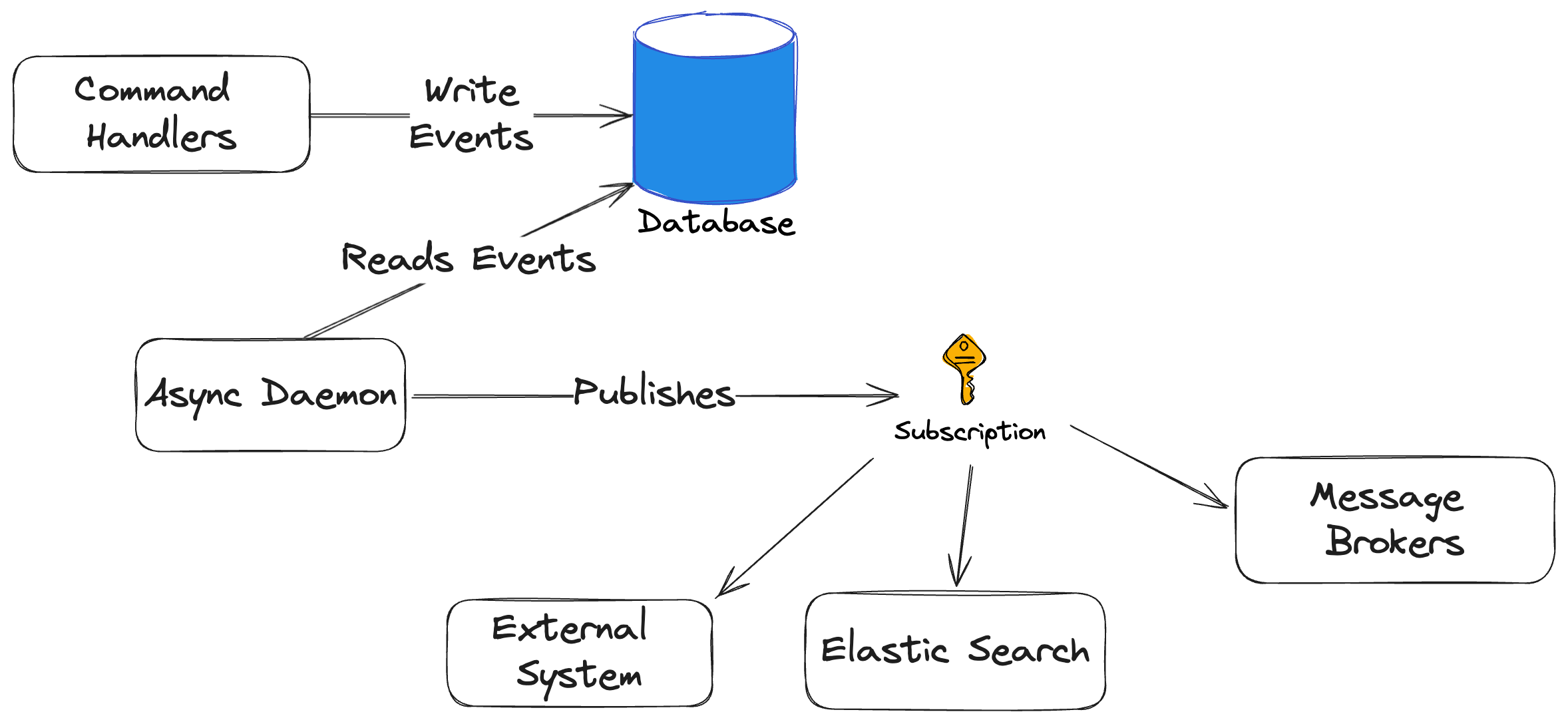
That’s part one. The next issue was that for users who also used Marten’s asynchronous projection feature, the “async daemon” subsystem in Marten needed to be able to discover new tenant databases in the background and ensure that all the asynchronous projections for these newly discovered databases are running in the background somewhere in the application. This led to a partial rewrite of the “async daemon” subsystem for Marten 7, but you can see the positive effect of that work in this test that “proves” that Marten is able to spin up projection building agents in the background at runtime:

    [Fact]
    public async Task add_tenant_database_and_verify_the_daemon_projections_are_running()
    {
        // In this code block, I'm adding new tenant databases to the system that I
        // would expect Marten to discover and start up an asynchronous projection
        // daemon for all three newly discovered databases
        var tenancy = (MasterTableTenancy)theStore.Options.Tenancy;
        await tenancy.AddDatabaseRecordAsync("tenant1", tenant1ConnectionString);
        await tenancy.AddDatabaseRecordAsync("tenant2", tenant2ConnectionString);
        await tenancy.AddDatabaseRecordAsync("tenant3", tenant3ConnectionString);

        // This is a new service in Marten specifically to help you interrogate or
        // manipulate the state of running asynchronous projections within the current process
        var coordinator = _host.Services.GetRequiredService<IProjectionCoordinator>();
        var daemon1 = await coordinator.DaemonForDatabase("tenant1");
        var daemon2 = await coordinator.DaemonForDatabase("tenant2");
        var daemon3 = await coordinator.DaemonForDatabase("tenant3");

        // Just proving that the configured projections for the 3 new databases
        // are indeed spun up and running after Marten's new daemon coordinator
        // "finds" the new databases
        await daemon1.WaitForShardToBeRunning("TripCustomName:All", 30.Seconds());
        await daemon2.WaitForShardToBeRunning("TripCustomName:All", 30.Seconds());
        await daemon3.WaitForShardToBeRunning("TripCustomName:All", 30.Seconds());
    }

Now, switching over to Wolverine 2.0 and its contribution to the party, the third part to make this dynamic tenant database discovery work throughout the entire “Critter Stack” was for Wolverine to be able to also discover the new tenant databases at runtime and spin up its “durability agents” for background message scheduling and its transactional inbox/outbox support. It’s admittedly not well at all documented yet, but Wolverine has an internal system for leader election and “agent assignment” between running nodes in an application cluster to distribute work. Wolverine uses this subsystem to distribute the transactional inbox/outbox work for each tenant database across the application cluster. Look for more information on this capability as JasperFx Software will be exploiting this for a different customer engagement this year.

Marten 7.0 is Released!

Marten 7.0 is released to the wild as of right now! Before getting into the highlights of what’s improved in this release, let’s go right to thanking some of the folks who made big contributions to this release either through code, testing, or feedback:

  • Oskar Dudycz and Babu Annamalai for being part of the core Marten team for most of its life
  • JT for all his feedback on the event sourcing feature set and being an early tester for us on the new LINQ support
  • Anne Erdtsieck for a slew of contributions both to Marten and the related Wolverine integration
  • Ben Edwards for advising us on event sourcing changes
  • Günther Foidl for making several suggestions on Marten’s execution pipeline, Npgsql usage, and for reviewing several very details pull requests
  • Mateusz Nowak for adding health checks to our asynchronous projection daemon
  • Zyrrio for sponsoring Marten!
  • Vedran Zakanj for sponsoring Marten and also contributing ideas around schema management
  • And a huge thanks to Lucas Wyland for specifically sponsoring the improved LINQ provider work with an equally huge apology from me on how long that took to finish

And to many more community members who helped improve Marten throughout this very long release cycle.

Highlights

This was a huge release, if not nearly as disruptive as Marten 4 was several years ago. I do not anticipate a lot of issues for users upgrading from Marten 6 to Marten 7, but see the migration guide for more details.

The highlights of Marten 7 are:

  • The LINQ query support was given a large overhaul that both expanded its supported use cases and led to significantly improved performance of many common sub collection queries — which has been a large complaint and request for improvement from the Marten community for several years
  • A “Partial” document update capability using native PostgreSQL functionality with no JavaScript in sight! That’s been a long requested capability.
  • The very basic database execution pipeline underneath Marten was largely rewritten to be far more parsimonious with how it uses database connections and to take advantage of more efficient Npgsql usage. We think these changes will make Marten both more efficient overall (these changes reduced the number of object allocations by quite a bit) and help system health through using fewer database connections
  • We introduced Polly for resiliency to transient errors like network hiccups or a temporarily overloaded database and actually made Marten able to properly execute retries of database writes and database reads
  • The “async daemon” subsystem was somewhat rewritten with substantial improvements for application scalability. The asynchronous projection support also has an all new scheme for resiliency that we think will be a big improvement for our users
  • An option to utilize Marten’s recommended FetchForWriting() API for “write model” aggregation with asynchronous projections. This may sound like a lot of mumbo jumbo, but it’s vital because this enables the next bullet point
  • The ability to do zero downtime deployments of some projection changes as well as to do blue/green deployments of revisioned projections. Much more on this later this week.
  • A new alternative for “revisioned” documents with a numeric version as an alternative to Marten’s existing GUID based versioning scheme for optimistic concurrency
  • We’ll see how big of a deal this turns out to be, but Marten 7 enables the usage of Project Aspire with Marten
  • Improved support for dynamically adding new tenant databases within Marten’s multi-tenancy support

As time permits, I will be writing deep dive blog posts on each of the individual bullet points above over the next couple weeks — partially as a way to force the completion of some not perfectly updated documentation!

You can Place a Technical Bet on Marten

There’s frequently an understandable hesitation on the part of software shops to take a bet on an open source tool as a critical piece of their technical infrastructure — and that’s sometimes worse in the .NET ecosystem where OSS adoption isn’t as widespread. All that aside, I’m here to tell you that you can feel safe making a large technical bet on Marten because:

  • Marten is already a very mature project that has been in production usage since its 1.0 release in 2016
  • While Marten doesn’t have every single issue around production support, deployments, and schema management fixed yet, we’ve got a detailed roadmap to shore up any remaining weaknesses of the tool and we’re in this for the long haul!
  • PostgreSQL itself is a very successful open source project that continuously innovates and provides a very solid technical foundation for Marten itself
  • Marten has a vibrant user community as you can see from the community involvement with GitHub and our Discord chat rooms.
  • We’ve invested a lot of time into refining Marten’s usability over the years and we think that attention to detail shines through
  • JasperFx Software offers support contracts and consulting work for Marten users
  • In conjunction with Wolverine’s integration with Marten, the full “Critter Stack” provides a very efficient and usable stack for Event Driven Architecture using Event Sourcing and a CQRS architecture
  • While Marten 7.0 made some significant improvements for scalability, the forthcoming “Critter Stack Pro” commercial add on tooling will take Marten to much larger data sets and transactional throughput
  • Because Marten does target .NET, it’s worth pointing out that at this point, Microsoft has no technical offerings for Event Sourcing and that will absolutely contribute to Marten’s viability

What’s Next and Summary

A lot of big, important, long requested, long planned features and improvements did not make the cut for V7. I blogged last week about the current roadmap for the entire Critter Stack. Moreover, some open bugs didn’t make it into 7.0 as well. And let’s be honest, there’s going to be a slew of bug reports streaming in this week when folks try out new 7.0 features and encounter usage permutations we didn’t anticipate. I’ve finally learned my lesson and made this release after having gotten some rest to be ready for whatever the issues turn out to be in the morning.

Wolverine 2.0 will also follow shortly, but the roadmap for that is pretty well just upgrading to Marten 7, dumping .NET 6, and fixing some low hanging fruit issues and requests before a release in the next couple days.

We’ll jump on whatever those Marten 7 issues turn out to be and all the questions about “what about *my* use case I don’t see on your list!” starting tomorrow, but for right now, this was a huge release filled with all kinds of substantial improvements that for the first time included significant client sponsored requests and please don’t steal my sunshine!

Talking with Isaac Levin on Coffee & Open Source

Isaac Levin was kind enough to have me on his Coffee & Open Source show to talk about a variety of topics around technology and my involvement with OSS work.

I need to update my profile here and there, that picture was taken on my late grandparents farm around Christmas of 2010 outside the titular Jasper, MO

I’d say that my time in OSS has long been valuable in terms of increased technical skillset and occasionally through opportunities that arose because of my OSS tools. It’s just now though that I’m finally living out my longstanding dream to make my “Critter Stack” OSS work (Marten & Wolverine) be my actual job as part of JasperFx Software.

Just to call a few highlights and to add to our conversation after having some time to think about things:

  • I made a double edged bit of advice at the end to “take your shot” when you have a technical idea that could become your job, but followed by an exhortation to stop working on something that isn’t bringing you joy or opportunities.
  • Unfortunately, failure is an awesomely effective teacher — if you let it be. I feel like the Critter Stack tools are succeeding right now, and plenty of that is due to some harsh lessons learned from my earlier failures in OSS.
  • OSS projects can succeed with a mix of having a conceptual idea or approach that appeals to enough folks, a dedicated core team of contributors like Oskar and Babu, and an enthusiastic and patient community that helps with suggestions, bug reports, and contributions. I called out Wolverine especially as a tool whose usability has largely been driven by the feedback of several early adopters. Moreover, one of the hard lessons learned from my earlier failure with FubuMVC is how important it is to get enough user feedback to sand off rough edges with a tool’s usability or documentation.
  • I personally find it very gratifying to be working on my projects, carrying out my vision, and generally having my hand on the steering wheel of Marten and Wolverine. I’m also enjoying the hands on consulting engagements I’m doing with the current JasperFx clients and making a positive difference for them. The obvious takeaway for me — and probably for a great number of you out there as well — is that I am much happier when I feel like I have significant ownership over the work and that my contributions are respected and valued by the customer, management, product owner, or colleagues. I’ve been consistently miserable in jobs or roles where I didn’t have either of those two things.

A Swag at the Critter Stack Road Map for Early 2024

From some notes that Oskar, Babu, and I banged out this past week, so keep your expectations for the quality of prose here! Notes in bold are my updates since this original document was banged out last weekend.

Marten 7.0

Try to release Marten 7.0 no later than early next week. This is admittedly based on JasperFx client deliverables.

  1. In flight work with async daemon and dynamic tenant databases. I think at this point it’s just finishing off that big PR. Done.
  2. Blue/green & zero downtime deployment. Ongoing work that just needs more testing at this point. This includes the projection version stuff. Actually all working locally, but my development branch is rebased on the daemon stuff, so I’d like that to go in first. Done.
  3. Update docs — Work in progress!
  4. Maybe try Project Aspire one more time? I think this could float to 7.1 as well. Likely to float to 7.1, but let’s see how this next week goes
  5. Triage bugs and minor issues

“Critter Stack Pro” work that might force breaking changes to Marten APIs. At *least* do some spikes:

  • Distributed async projections. This one’s the big one. Proceeding well, did cause a few changes to Marten so far
  • Projection Snapshots – I’d really like to see this mostly land in Critter Stack Pro. Probably not happening until 2nd quarter 2024
  • First class subscriptions from the event store to Wolverine transports – might be in Wolverine 2.0 proper. Dunno. Not sure yet
  • Async projection optimizations – Probably not happening until 2nd quarter 2024
    • 2nd level caching for aggregates
    • Rebuild single stream projections stream by stream
    • Allow for selective identity map usage of reference types. 
    • Batched data lookups – so you can keep projections from doing chatty data access
    • Allow grouping logic to express optimization hints like “no data access required” or “requires aggregate state”. That could be used to optimize projection rebuilds

Wolverine 2.0

  • Discovery and activation of new tenant databases at runtime (client deliverable). Done.
  • Update to Marten 7
  • Project Aspire? Wolverine 2.1? This is a little more involved, so I’m not sure yet when this lands. Probably in Wolverine 2.1.

Marten 7.1

  1. Open Telemetry Support – Sean Farrow is working on this. I don’t think it’s going to be a breaking change, so could float to 7.1. Very Basic
  2. Sharding the event store tables – I’d love to do this sooner, and would love to stretch this in. I’m saying that we would tackle the is archived / not archived sharding in a first pass, then come back w/ fancier sharding possibilities later. This would have a potentially huge positive implication for Marten event store scalability.
  3. The ability to “emit” new events in the async daemon during the course of processing asynchronous projections. I think this is going to take some spikes and analysis, so we gotta commit to this ASAP if it’s going into 7.0. This is falling to Marten 7.1
  4. Strong-typed identifiers – it’s a ton of work I really don’t want to take on in a rush (Jeremy)
  5. First class subscriptions. Hot, cold, replay, whatever. I just want a little more time and space. Does this require any breaking changes in the daemon we might want to deal with right now though? Very likely dropping to Marten 7.1
  6. Custom event type naming strategy – it’s a breaking change to the API I think. I don’t think it’s huge though – little pluggable strategy. Can be additive.
  7. Optimize inline projections in FetchForWriting()? Idea here is to force aggregates that are calculated Inline (or Async maybe) that are queried in FetchForWriting() be forced to use the identity map for just that document type. That does a lot to optimize the typical “aggregate handler workflow” by avoiding the current double fetching of the document when you are using lightweight sessions. Strong candidate to drop down to 7.1

Marten 7.Later

  • Downcasters – I vote to put this into Critter Stack Pro all the way

Marten 8.0???

  • More advanced Event Store partitioning

Wolverine 2.1

  • Likely a focus on the Wolverine.HTTP backlog
  • Options for strict ordering requirements of event or message processing

Sneak Peek at “Critter Stack Pro” for Big Time Event Store Scalability

Hey, did you know that JasperFx Software is ready for formal support plans for Marten and Wolverine? Not only are we making the “Critter Stack” tools be viable long term options for your shop, we’re also interested in hearing your opinions about the tools and how they should change. We’re also certainly open to help you succeed with your software development projects on a consulting basis whether you’re using any part of the Critter Stack or some completely different .NET server side tooling.

In the continuing saga of trying to build a sustainable business model around Marten and Wolverine (the “Critter Stack”), JasperFx Software is quietly building a new set of tools code named “Critter Stack Pro” as a commercially licensed add on to the MIT-licensed OSS core tools.

While there’s some very serious progress on a potential management user interface tool for Marten & Wolverine features underway, the very first usable piece will be a new library for scaling Marten’s asynchronous projection model by much more efficiently distributing work across a clustered application than Marten by itself can today.

In the first wave of work, we’re aiming for this feature set:

  • When using a single Marten database, the execution of asynchronous projections will be distributed evenly across the application cluster
  • When using multiple Marten databases for multi-tenancy, the execution of asynchronous projections will be distributed by database and evenly across the application cluster
  • In blue/green deployments, “Critter Stack Pro” will be able to ensure that all known versions of each projection and database are executing in a suitable “blue” or “green” node within the application cluster
  • When using multiple Marten databases for multi-tenancy and also using the new dynamic tenant capability in Marten 7.0, “Critter Stack Pro” will discover the new tenant databases at runtime and redistribute projection work across the application cluster
  • “First class subscriptions” of Marten events with strict ordering through any of Wolverine’s supported messaging transports (locally, Rabbit MQ, Kafka, Azure Service Bus, AWS SQS, soon to be more!).

We’re certainly open to more suggestions from long term and potential users about what other features would make “Critter Stack Pro” a must have tool for your production environment. Trigger projection projection rebuilds on demand? Apply a new subscription? Pause a subscription? Force “Critter Stack Pro” to redistribute projections across the cluster? Smarter distribution algorithms based on predicted load? Adaptive distribution based on throughput?

And do know that we’re already working up a potential user interface for visualizing and monitoring Marten and Wolverine’s behavior at runtime.

This new product (knock on wood) is going to be delivered to a JasperFx customer within the next week or two for integration into their systems using Marten 7.0 and Wolverine 2.0 (also not coincidentally forthcoming at the end of the next week). I’m not going to commit to when this will be generally available, but I’d sure hope it’s sometime in the 2nd quarter this year.

Answering Some Concerns about Wolverine

Nick Chapsas just released a video about Wolverine with his introduction and take on the framework. Not to take anything away from the video that was mostly positive, but I thought there were quite a few misconceptions about Wolverine evident in the comments and some complaints I would like to address so I can stop fussing about this and work on much more important things.

First off, what is Wolverine? Wolverine is a full blown application framework and definitely not merely a “library,” so maybe consider that when you are judging the merits of its opinions or not. More specifically, Wolverine is a framework built around the idea of message processing where “messages” could be coming from inline invocation like MediatR or local in process queues or external message brokers through asynchronous messaging ala the much older MassTransit or NServiceBus frameworks. In addition, Wolverine’s basic runtime pipeline has also been adapted into an alternative HTTP endpoint framework that could be used in place of or as a complement to MVC Core or Minimal API.

I should also point out that Wolverine was largely rescued off the scrap heap and completely rebooted specifically to work in conjunction with Marten as a full blow event driven architecture stack. This is what we mean when we say “Critter Stack.”

In its usage, Wolverine varies quite a bit from the older messaging and mediator tools out there like NServiceBus, MassTransit, MediatR, Rebus, or Brighter.

Basically all of these existing tools one way or another force you to constrain your code within some kind of “IHandler of T” abstraction something like this:

public interface IHandler<T>
{
    Task HandleAsync(T message, MessageContext context, CancellationToken cancellationToken);
}

By and large, these frameworks assume that you will be using an IoC container to fill any dependencies of the actual message handler classes through constructor injection. Part of the video I linked to was the idea that Wolverine was very opinionated, so let’s just get to that and see how Wolverine very much differs from all the older “IHandler of T” frameworks out there.

Wolverine’s guiding philosophies are to:

  • Reduce code ceremony and minimize coupling between application code and the surrounding framework. As much as possible — and it’s an imperfect world so the word is “minimize” and not “eliminate” — Wolverine attempts to minimize the amount of code cruft from required inheritance, marker interfaces, and attribute usage within your application code. Wolverine’s value proposition is that lower ceremony code leads to easier to read code that offsets any disadvantages that might arise from using conventional approaches
  • Promote testability — both by helping developers structure code in such a way that they can keep infrastructure concerns out of business logic for easy unit testing and to facilitate effective automated integration testing as well. I’ll throw this stake in the ground right now, Wolverine does much more to promote testability than any other comparable framework that I’m aware of, and I don’t mean just .NET frameworks either (Proverbs 16:18 might be relevant here, but shhh).
  • “It should just work” — meaning that as much as possible, Wolverine should try to set up infrastructural state (database schemas, message broker configuration, etc.) that your application depends on for an efficient developer experience
  • Provide effective diagnostics for any “magic” in the framework. See Unraveling the Magic in Wolverine to see what I mean.
  • Bake in logging, auditing, and observability so that developers don’t have to think about it. This is partially driven by the desire for low code ceremony because nothing is more repetitive in systems than copy/paste log statements every which way
  • Be as performant as possible. Wolverine is descended and influenced by an earlier failed OSS project called FubuMVC that strived for very low code ceremony and testability, but flunked on performance and how it handled “magic” conventions. Let’s just say that failure is a harsh but effective teacher. In particular, Wolverine tries really damn hard to reduce the number of object allocations and dictionary lookups at runtime as those are usually the main culprits of poor performance in application frameworks. I fully believe that before everything is said and done, that Wolverine will be able to beat the other tools in this space because of its unique runtime architecture.

A Wolverine message handler might look something like this from one of our samples in the docs that happens to use EF Core for persistence:

public static class CreateItemCommandHandler
{
    public static ItemCreated Handle(
        // This would be the message
        CreateItemCommand command,

        // Any other arguments are assumed
        // to be service dependencies
        ItemsDbContext db)
    {
        // Create a new Item entity
        var item = new Item
        {
            Name = command.Name
        };

        // Add the item to the current
        // DbContext unit of work
        db.Items.Add(item);

        // This event being returned
        // by the handler will be automatically sent
        // out as a "cascading" message
        return new ItemCreated
        {
            Id = item.Id
        };
    }
}

There’s a couple things I’d ask you to notice right off the bat that will probably help inform you if you’d like Wolverine’s approach or not:

There’s no required IHandler<T> type interface. Nor do we require any kind of IMessage/IEvent/ICommand interface on the message type itself

The method signatures of Wolverine message handlers are pretty flexible. Wolverine can do “method injection” like .NET developers are used to now in Minimal API or the very latest MVC Core where services from the IoC container are pushed into the handler methods via method parameters (Wolverine will happily do constructor injection just like you would in other frameworks as well). Moreover, Wolverine can even do different things with the handler responses like “know” that it’s a separate message to publish via Wolverine or a “side effect” that should be executed inline. Heck, the message handlers can even be static classes or methods to micro-optimize your code to be as low allocation as possible.

Wolverine is not doing any kind of runtime Reflection against these handler methods, because as a commenter pointed out, this would indeed be very slow. Instead, Wolverine is generating and compiling C# code at runtime that wraps around your method. Going farther, Wolverine will use your application’s DI configuration code and try to generate code that completely takes the place of your DI container at runtime. Some folks complain that Wolverine forces you to use Lamar as the DI container for your application, but doing so enabled Wolverine to do the codegen the way that it is. Nick pushed back on that by asking what if the built in DI container becomes much faster than Lamar (it’s the other way around btw)? I responded by pointing out that the fasted DI container is “no DI container” like Wolverine is able to do at runtime.

The message handlers are found by default through naming conventions. But if you hate that, no worries, there are options to use much more explicit approaches. Out of the box, Wolverine also supports discovery using marker interfaces or attributes. I don’t personally like that because I think it “junks up the code”, but if you do, you can have it your way.

The handler code above was written with the assumption that it’s using automatic transactional middleware around it all that handles the asynchronous code invocation, but if you prefer explicit code, Wolverine happily lets you eschew any of the conventional magic and write explicit code where you would be completely in charge of all the EF Core usage. The importance of being able to immediately bypass any conventions and drop into explicit code as needed was an important takeaway from my earlier FubuMVC failure.

    Various Objections to Wolverine

    • It’s opinionated, and I don’t agree with all of Wolverine’s opinions. This one is perfectly valid. If you don’t agree with the idiomatic approach of a software development tool, you’re far better off to just pick something else instead of fighting with the tool and trying to use it differently than its idiomatic usage. That goes for every tool, not just Wolverine. If you’d be unhappy using Wolverine and likely to gripe about it online, I’d much rather you go use MassTransit.
    • Runtime reflection usage? As I said earlier, Wolverine does not use reflection at runtime to interact with the message handlers or HTTP endpoint methods
    • Lamar is required as your IoC tool. I get the objection to that, and other people have griped about that from time to time. I’d say that the integration with Lamar enables some of the very important “special sauce” that makes Wolverine different. I will also say that at some point in the future we’ll investigate being able to at least utilize Wolverine with the built in .NET DI container instead
    • Oakton is a hard dependency, and why is Wolverine mandating console usage? Yeah, I get that objection, but I think that’s very unlikely to ever really matter much. You don’t have to use Oakton even though it’s there, but Wolverine (and Marten) both heavily utilize Oakton for command line diagnostics that can do a lot for infrastructure management, environment checks, code generation, database migrations, and important diagnostics that help users unravel and understand Wolverine’s “magic”. We could have made that all be separate adapter package or add ons, but from painful experience, I know that the complexity of usage and development of something like Wolverine goes up quite a bit with the number of satellite packages you use and require — and that’s already an issue even so with Wolverine. I did foresee the Lamar & Oakton objections, but consciously decided that Wolverine development and adoption would be easier — especially early on — by just bundling things together. I’d be willing to reconsider this in later versions, but it’s just not up there in ye olde priority list
    • There are “TODO” comments scattered in the documentation website! There’s a lot of documentation up right now, and also quite a few samples. That work is never, ever done and we’ll be improving those docs as we go. The one thing I can tell you definitively about technical documentation websites is that it’s never good enough for everyone.

    Side Effects vs Cascading Messages in Wolverine

    Hey, did you know that JasperFx Software is ready for formal support plans for Marten and Wolverine? Not only are we making the “Critter Stack” tools be viable long term options for your shop, we’re also interested in hearing your opinions about the tools and how they should change. We’re also certainly open to help you succeed with your software development projects on a consulting basis whether you’re using any part of the Critter Stack or some completely different .NET server side tooling.

    Wolverine has a pair of features called cascading messages and side effects that allow users to designate “work” that happens after your main message handler or HTTP endpoint method. In our Discord room this week, there was a little bit of user confusion over what the difference was and when you should use one or the other. To that end, let’s do a little dive into what both of these features are (both are unique to Wolverine and don’t have analogues to the best of my knowledge in any other messaging or command processing framework in the .NET space).

    First, let’s take a look at “side effects.” Here’s the simple example of a custom “side effect” from the Wolverine documentation to write string data to a file on the file system:

    public class WriteFile : ISideEffect
    {
        public string Path { get; }
        public string Contents { get; }
    
        public WriteFile(string path, string contents)
        {
            Path = path;
            Contents = contents;
        }
    
        // Wolverine will call this method. 
        public Task ExecuteAsync(PathSettings settings)
        {
            if (!Directory.Exists(settings.Directory))
            {
                Directory.CreateDirectory(settings.Directory);
            }
            
            return File.WriteAllTextAsync(Path, Contents);
        }
    }
    

    And a message handler that uses this custom side effect:

    public class RecordTextHandler
    {
        public WriteFile Handle(RecordText command)
        {
            return new WriteFile(command.Id + ".txt", command.Text);
        }
    }
    

    A Wolverine “side effect” really just designates some work that should happen inline with your message or HTTP request handling, so we could eschew the “side effect” and rewrite our message handler as:

        public Task Handle(RecordText command, PathSettings settings)
        {
            if (!Directory.Exists(settings.Directory))
            {
                Directory.CreateDirectory(settings.Directory);
            }
            
            return File.WriteAllTextAsync(command.Id + ".txt", command.Text);
        }
    

    The value of the “side effect” usage within Wolverine is to allow you to make a message or HTTP endpoint method be responsible for deciding what to do, without coupling that method and its logic to some kind of pesky infrastructure like the file system that becomes a pain to deal with in unit tests. The “side effect” object returned from a message handler or HTTP endpoint is running inline within the same transaction (if there is one) and retry loop for the message itself.

    On the other hand, a cascading message is really just sending a subsequent message after the successful completion of the original message. Here’s an example from the “Building a Critter Stack Application” blog series:

        [WolverinePost("/api/incidents/categorise"), AggregateHandler]
        // Any object in the OutgoingMessages collection will
        // be treated as a "cascading message" to be published by
        // Wolverine after the original CategoriseIncident command
        // is successfully completed
        public static (Events, OutgoingMessages) Post(
            CategoriseIncident command, 
            IncidentDetails existing, 
            User user)
        {
            var events = new Events();
            var messages = new OutgoingMessages();
            
            if (existing.Category != command.Category)
            {
                events += new IncidentCategorised
                {
                    Category = command.Category,
                    UserId = user.Id
                };
    
                // Send a command message to try to assign the priority
                messages.Add(new TryAssignPriority
                {
                    IncidentId = existing.Id
                });
            }
    
            return (events, messages);
        }
    }
    

    In the example above, the TryAssignPriority message will be published by Wolverine to whatever subscribes to that message type (local queues, external transports, nowhere because nothing actually cares?). The “cascading messages” are really the equivalent to calling IMessageBus.PublishAsync() on each cascaded message. It’s important to note that cascaded messages are not executed inline with your original message. Instead, they are only published after the original message is completely handled, and will run in completely different contexts, retry loops, and database transactions.

    To sum up, you would:

    1. Use a “side effect” to select actions that need to happen within the current message context as part of an atomic transaction and as something that should succeed or fail (and be retried) along with the message handler itself and any other middleware or post processors for that message type. In other words, “side effects” are for actions that should absolutely happen right there and now!
    2. Use a “cascaded message” for a subsequent action that should happen after the current message, should be executed within a separate transaction, or could be retried in its own retry loop after the original message handling has succeeded.

    I’d urge users to consider the proper transaction boundaries and retry boundaries to decide which approach to use. And remember that in both cases, there is value in trying to use pure functions for any kind of business or workflow logic — and both side effects and cascaded messages help you do exactly that for easily unit testable code.

    Ongoing Scalability Improvements for Marten 7

    Hey, did you know that JasperFx Software is ready for formal support plans for Marten and Wolverine? Not only are we making the “Critter Stack” tools be viable long term options for your shop, we’re also interested in hearing your opinions about the tools and how they should change. We’re also certainly open to help you succeed with your software development projects on a consulting basis whether you’re using any part of the Critter Stack or some completely different .NET server side tooling.

    I checked this morning, and Marten’s original 1.0 release was in September of 2016. Since then we as a community have been able to knock down several big obstacles to user adoption, but one pernicious concern of new users was the ability to scale the asynchronous projection support to very large loads as Marten today only supports a “hot/cold” model where all projections run in the same active process.

    Two developments are going to finally change that in the next couple weeks. First off, the next Marten 7 beta is going to have a huge chunk of work on Marten’s “async daemon” process that potentially distributes work across multiple nodes at runtime.

    By (implied) request:

    In the new Marten 7 model:

    • If you are targeting a single database, Marten will do its potential ownership of each projection independently. We’re doing this by using PostgreSQL advisory locks for the determination of ownership on a projection by projection basis. At runtime, we’re using a little bit of randomness so that if you happen to start up multiple running application nodes at the same time, the different nodes will start checking for that ownership at random times and do so with a random order of the various projections. It’s not fool proof by any means, but this will allow Marten to potentially spread out the projections to different running application instances.
    • If you are using multi-tenancy through separate databases, Marten’s async daemon will similarly do an ownership check by database, and keep all the projections for a single database running on the same node. This is done with the theory that this should potentially reduce the number of database connections used overall by your system. As in the previous bullet for a single tenant, there’s some randomness introduced so each application instance doesn’t try to get ownership of the same databases at the same time and potentially cause dead lock situations. Likewise, Marten is randomizing the order in which it attempts to check the ownership of different databases so there’s a chance this strategy will distribute work across multiple nodes.

    There’s some other improvements so far (with hopefully much more to follow) that we hope will increase the throughput of asynchronous projections, especially for projection rebuilds.

    I should also mention that a JasperFx Software client has engaged us to improve Marten & Wolverine‘s support for dynamic utilization of per tenant databases where both Marten & Wolverine are able to discover new tenant databases at runtime and activate all necessary support agents for the new databases. That dynamic tenant work in part led to the async projection work I described above.

    Let’s go even farther…

    I’ll personally be very heads down this week on some very long planned work (sponsored by a JasperFx Software client!!!) for a “Critter Stack Pro” tool set to extend Marten’s event store to much larger data sets and throughput. This will be the first of a suite of commercial add on tools to the “Critter Stack”, with the initial emphasis being:

    • The ability to more effectively distribute asynchronous projection work across the running instances of the application using a software-based “agent distribution” already built into Wolverine. We’ll have some simple rules for how projections are distributed upfront, but I’m hoping to evolve into adaptive rules later that can adjust the distribution based on measured load and performance metrics
    • Zero-downtime deployments of Marten projection changes
    • Blue/green deployments of revisioned Marten projections and projected aggregates, meaning that you will be able to deploy a new version of a Marten projection in some running instances of a server applications while the older version is still functional in other running instances

    I won’t do anything silly like put a timeframe around this, but the “Critter Stack Pro” will also include a user interface management console to watch and control the projection functionality.

    It’s Critter Stack “Release on Friday” Party!

    Hey, did you know that JasperFx Software is ready for formal support plans for Marten and Wolverine? Not only are we trying to make the “Critter Stack” tools be viable long term options for your shop, we’re also interested in hearing your opinions about the tools and how they should change. We’re also certainly open to help you succeed with your software development projects on a consulting basis whether you’re using any part of the Critter Stack or any other .NET server side tooling.

    A lot of pull requests and bug fixes just happened to land today for both Marten and Wolverine. In order, we’ve got:

    Marten 7.0.0 Beta 5

    Marten 7.0.0 Beta 5 is actually quite a big release and a major step forward on the road to the final V7 release. Besides some bug fixes, I think the big highlights are:

    • Marten finally gets the long awaited “Partial Update” model that only depends on native PosgreSQL features! Huge addition from Babu. If you’re coming to Marten from MongoDb, or only would if Marten had the ability to modify documents without first having to load the whole thing, well now you can! No PLv8 extension necessary!
    • We pushed through a new low level execution model that’s more parsimonious about how long database connections are kept open that should help applications using Marten scale to more concurrent transactions. This should also help folks using Marten in conjunction with Hot Chocolate as now IQuerySession could be used in multiple threads in parallel.
    • Marten now uses Polly internally for retries on transient errors, and the “retry” functionality actually works now (it didn’t actually do anything useful before, as I shamefully refuse to make eye contact with you).
    • Several fixes around full text indexes that were blocking some folks

    Wolverine 1.16.0

    Wolverine 1.16.0 came out today with a couple additions and fixes related to MQTT or Rabbit MQ message publishing to topics. As an example, here’s some new functionality with Rabbit MQ message publishing:

    You can specify publishing rules for messages by supplying the logic to determine the topic name from the message itself. Let’s say that we have an interface that several of our message types implement like so:

    public interface ITenantMessage
    {
        string TenantId { get; }
    }
    

    Let’s say that any message that implements that interface, we want published to the topic for that messages TenantId. We can implement that rule like so:

    using var host = await Host.CreateDefaultBuilder()
        .UseWolverine((context, opts) =>
        {
            opts.UseRabbitMq();
    
            // Publish any message that implements ITenantMessage to 
            // a Rabbit MQ "Topic" exchange named "tenant.messages"
            opts.PublishMessagesToRabbitMqExchange<ITenantMessage>("tenant.messages",m => $"{m.GetType().Name.ToLower()}/{m.TenantId}")
                
                // Specify or configure sending through Wolverine for all
                // messages through this Exchange
                .BufferedInMemory();
        })
        .StartAsync();
    

    Wolverine 2.0 Alpha 1

    Knock on wood, if the GitHub Action & Nuget gods all agree, there will be a Wolverine 2.0 alpha 1 set of Nugets available that’s just Wolverine 1.16, but targeting the very latest Marten 7 betas as somebody asks me just about every single day when that’s going to be ready.

    Enjoy! And don’t tell me about any problems with these releases until Monday!

    Summary

    I had a very off week as I struggled with a cold, a busy personal life, and way more Zoom meetings than I normally have. All the same, getting to spit out these three releases today makes me feel like Bill Murray here:

    And again, new bug reports can wait for Monday!